San Francisco
When you look at a painting of parfaits and sundaes by Wayne Thiebaud, do you think of the bottles and vessels lined up in the still lifes of Giorgio Morandi? Or view a row of his cupcakes and see Monet's grain stacks? His "Display Cakes" (1963) and acknowledge a strange similarity between the placement of those cakes and the hats in Degas's "The Millinery Shop" (1874-86)?
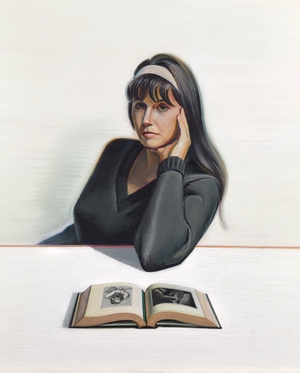 "Betty Jean Thiebaud and Book" |
You may now. It might come as a surprise even to ardent fans of Thiebaud's sunny, brightly colored, impasto depictions of everyday life to learn that behind many of his paintings, there's another painting. Yet as Thiebaud (1920-2021) himself once said: "My world is one of crime. I steal from every artist around the world."
Plenty of evidence is on view in "Wayne Thiebaud: Art Comes From Art" at the San Francisco Legion of Honor through Aug. 17. Curated by the museum's Timothy Anglin Burgard, the exhibition presses the case that Thiebaud was a painter's painter, mining art history, luxuriating in the physicality of paint, intent on imparting and eliciting emotion—and, implicitly, not a practitioner of affectless, consumerist Pop art, with which he is frequently associated. Seeking both inspiration and insight into artistic practice, Thiebaud copied works by artists he admired not just as a neophyte, but at least until he was 80 years old. He collected them, too: 37 works, ranging from an 1817 drawing by Jean-Auguste-Dominique Ingres to a 1993 painting by Frank Auerbach, a German-born figurative painter, are on view in the introductory gallery, along with many of his copies—a prelude to the 65 original Thiebauds that follow.
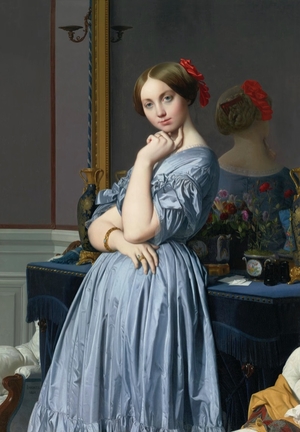 Comtesse d'Haussonville |
Visitors first meet "Betty Jean Thiebaud and Book" (1965-69), a portrait of the artist's wife that embodies the show's thesis. Leaning on her elbow, hand on cheek, her mane of salt-and-pepper hair meeting her charcoal sweater, she strikes a pose that, as the wall label indicates, recalls at least four art-historical masterpieces: Dürer's "Melancholia I" (1514), Ingres's "Comtesse d'Haussonville" (1845), Degas's "Portrait of Edmond Duranty" (1879) and Picasso's "Woman With a Book" (1932).
Exhibition-goers are now primed to see clues in Thiebaud's paintings that they probably missed before. The next gallery, the first of four hung loosely chronologically, presents his "Guitar" (1962/2002). This straightforward image on a white background, with a slight shadow, clearly mimics Picasso's sheet-metal "Guitar" (1914), shown (as all inspirational works are) in an accompanying thumbnail image. It's an example of what Mr. Burgard categorizes as overt homage, just as Thiebaud's shiny "Black Shoes" (2018) honor, but contrast with, Van Gogh's depictions of battered shoes.
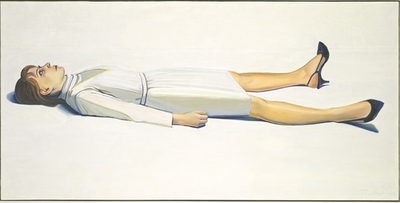 Supine Woman |
Thiebaud's other approaches, termed "covert theft" and "intuitive transformation," are more engrossing. His "Eating Figures (Quick Snack)" from 1963 shows a couple, sitting on barstools against a white background, eating hot dogs and balancing candy-striped milkshake cups on their thighs. Eyes half-closed, they look alienated from each other and the world. Compare it with Degas's "L'Absinthe" (1875-76), showing a similar couple in a drab café, also disenchanted and unable to find solace in their choice of calmative. Even more provocatively, the exhibit likens Degas's "The Bellelli Family" (1858–69), a complex masterpiece of an unhappy couple and their two girls whose positioning broadcasts their estrangement, with Thiebaud's "Five Seated Figures" (1965). In it, similarly expressionless adults sit in a more balanced grouping, but also disassociated, avoiding eye contact. Thiebaud has torn up Degas's compositions but aimed to create similar moods using analogous elements.
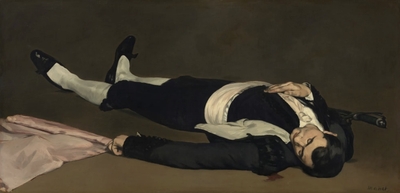 The Dead Man |
Thiebaud greatly admired Manet. His "Supine Woman" (1963), depicting a female dressed in white, flat on her back, is the uncanny opposite of Manet's "The Dead Man" (1864-65), which portrays a toreador in black costume. Manet's great "A Bar at the Folies-Bergère" (1882) prompted at least a dozen Thiebaud paintings, with two here (along with a copy he made of the waitress): the buxom "Makeup Girl" (1981–2012), with noticeably similar long bangs and a direct, disconsolate gaze, offers cosmetics at a department store counter, not drinks at a bar. "Woman in White Hat" (2014/15) stares out too, but seems to be putting on makeup before a mirror—perhaps referring to the mysterious one in Manet's painting.
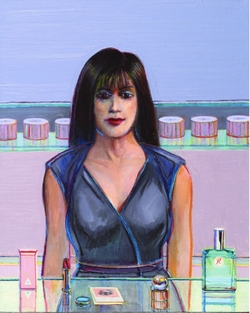 Makeup Girl |
While he is known as a figurative painter, Thiebaud's artistic net extended to abstract painters. His "Electric Chair" (1957)—a seat, in a tangle of wires and drips, rendered in black against a red background—reinterprets Franz Kline's abstract "The Bridge" (1955), whose bold, broad strips of black Thiebaud saw in New York. A semi-figurative still life, "French Fries" (1961)—a dish sitting above what might be a black tray that occupies most of the painting, riffs on Rothko's moody color-block paintings. And "Road Through" (1983)—a narrow black street passing between two steep cliffs—refers to Barnett Newman's "zip" paintings.
Although "Art Comes From Art" in no way provides a full view of Thiebaud, it does present a key to how he thought—consciously and unconsciously. When he is not appropriating, he inverts; he reverses; he playfully injects humor; he changes pivotal colors and viewpoints; he deconstructs to reconstruct, and he comes up with something original. With this in mind, "Art Comes From Art" invites audiences to look closely at Thiebaud's paintings, to remember (or learn) art history, and to find more in his works than they see on first glance.