



High up on the Bolivian Altiplano, Potosí was once a glorious "imperial city," deemed by Holy Roman Emperor Charles V to be the "Treasure of the World." Starting around 1545, when a bountiful silver deposit was discovered in a mountain that came to be known as "Cerro Rico," or rich hill, the indigenous village at its foot exploded with fortune-seekers from abroad, becoming a bustling city larger than any other in the Americas, with a population that in the 1600s roughly equaled London's. Exploited by the Spanish—who forced local laborers and enslaved Africans to work in dangerous mines and refining mills—Potosí's silver operations were reputed to be the world's largest industrial complex in the 16th century. They created fabulous wealth, financed the expansion of Spain's empire, elevated its global standing, and helped trigger the Industrial Revolution.
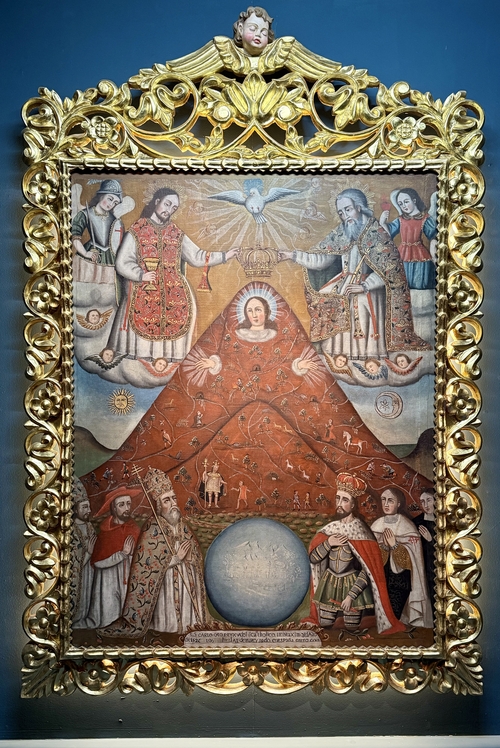 Catholic missionaries arrived, too, and with them came the flourishing of religious art used to inspire and convert the native peoples. As elsewhere, in Potosí, which is about 50 miles by air from Sucre, the judicial capital of Bolivia, Andean artists adopted European painting practices but sometimes injected symbols and motifs from their own beliefs into their works. Nowhere is this more striking than in "The Virgin of Cerro Rico" (before 1720) by an anonymous Andean artist. A few similar paintings exist, but none is as iconographically rich or as beautifully executed, none as perfect a match between image and intent, as this Virgin, located today in Potosí's Casa Nacional de la Moneda (Mint).
Marian images are common in viceregal art—the Virgin played an important role in converting peoples—and many simply copy traditional European depictions. But some Andeans, like this artist, equated the Virgin with Pachamama, or "Mother Earth," their omnipresent mountain goddess who provided for life itself (but was also capable of causing calamity). Just as life came through Pachamama, they believed, Mary was chosen by God as the mother through whom he sent his Son, who gave humanity the path to eternal life.
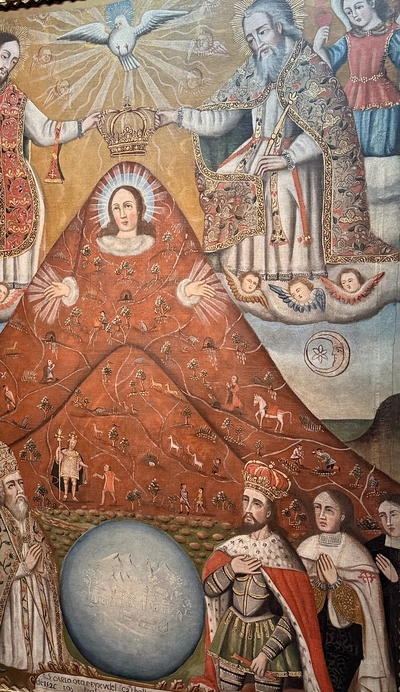
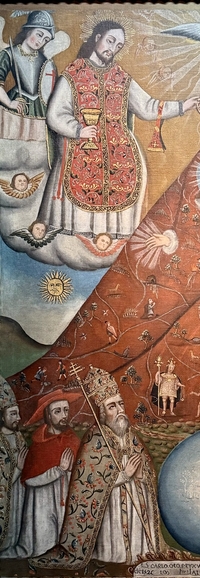 These two world views are manifest throughout the rest of the painting. At the top, Mary is crowned by the Trinity: God the Father on the right holding a scepter; Jesus on the left in priestly vestments and holding a chalice; the Holy Spirit in the form of a dove in the center. They stand on clouds, supported by cherubs, attended by the warrior archangel Michael with his sword and another archangel (probably Raphael) with a heart. It's all very Euro-traditional.
Below this scene, though, the artist alludes to indigenous traditions: He positions Mary between the sun, placed in the sky under Jesus, and the moon, located below God the Father, which were the Incan gods of life and light and of time cycles, rituals and femininity, respectively. Some scholars have suggested that though their faces do not look upward, they are bearing witness to Mary's coronation and thus engaging with colonial religious views.
In this middle area, too, a landscape and the sea, also associated with Incan gods, are visible above a stone wall much like those the Incas built. Intriguingly, a large figure stands on the mountain just behind this wall: It is the Sapa Inca—or ruler—identifiable by the sun on his tunic, the scepter in his hand, and his elaborate headdress.
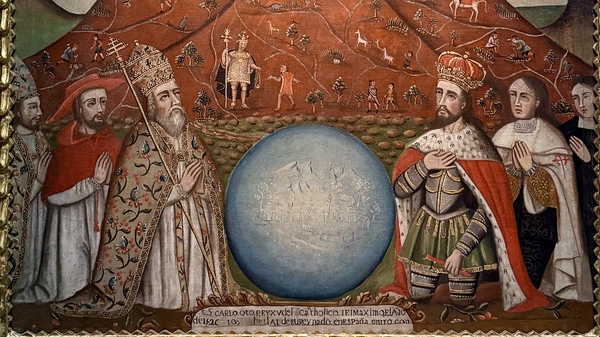
 In the mid-16th century, however, Spanish conquistadors had defeated the Incas in Bolivia, and the Sapa Inca's size pales in comparison with the figures in the painting's lower third. Here the artist depicted, on the left, a bishop and a cardinal led by Pope Paul III, and on the right, Charles V, a gentleman thought to be the donor, and a cacique—an indigenous authority (or chief) who often functioned as a bridge to the Spanish powers. Between them lies a globe illuminated by a view of Potosí, the domain they all shared, if unequally.
Some experts believe that the painting—the lower scene in particular—affirms the notion that Spain was chosen by God to colonize South America and reap the ensuing benefits. If so, the artist also added a dollop of doubt with his overt local touches. Yet it's clear that the artist did see Mary as benevolent, given her complete association with the mountain, which had long been an Andean sacred site, a place where and to which native people prayed.
Potosí faded in the 18th century, after even richer deposits were discovered in Mexico. But in its mint, now a museum, the "Virgin" still shines. She is the epitome of the way Christianity was able to grow in South America by adapting belief symbols already accepted by indigenous inhabitants.