



San Francisco
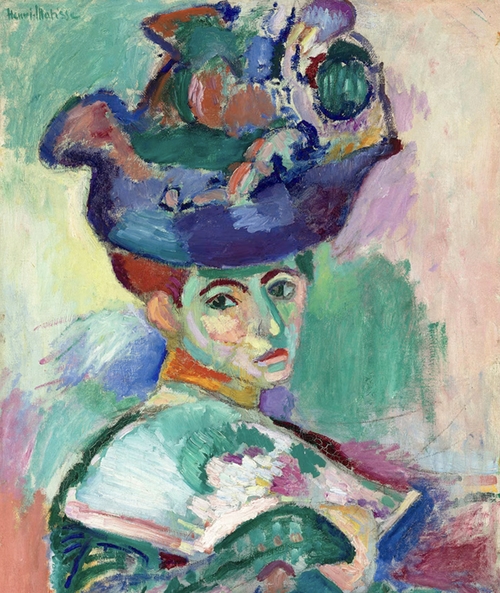
In late summer 1905, as Henri Matisse was preparing for the Salon d'Automne, he decided to add a portrait to the colorful landscapes he had created that year in Collioure, in southern France. Using spontaneous brushstrokes, he painted his wife, Amélie, with strange green skin (save for a rosy cheek and her ear), a direct gaze and an elaborate blue hat. Critics at the Salon raged. "A pot of paint has just been thrown in the public's face," howled one; another famously called Matisse and fellow artists in the Salon's Gallery VII "wild beasts" ("fauves" in French). Even Leo Stein, the American expatriate proponent of avant-garde art, called it "brilliant and powerful, but the nastiest smear of paint I had ever seen."
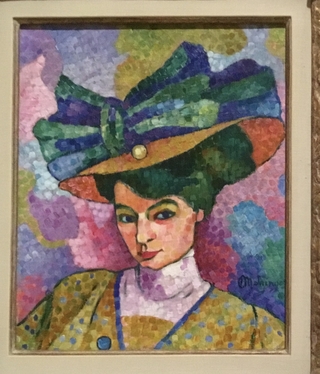 Metzinger's version |
There they will see a stripped-down version of Gallery VII, with 27 examples by all 10 artists, from Matisse and Marquet to André Derain and Maurice de Vlaminck, who contributed the 55 artworks displayed in that space. As if to underscore the radical turn these artists were making, the paintings are hung on an ornate plum-red wallpaper in a wainscoted gallery that harks back to the Grand Palais's look.
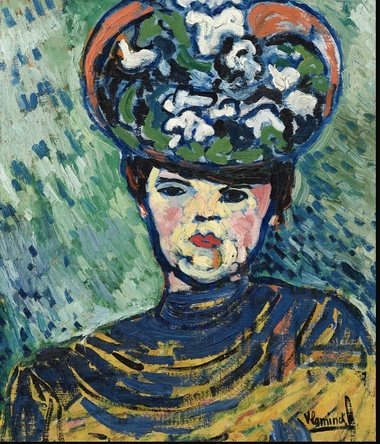 Vlaminck's version |
What is obvious is Matisse's superiority; little wonder that he was attacked. "Open Window, Collioure" (1905)—depicting sailboats on the water seen through a large window in a room with green, peach and hot-pink walls—is an early example of what became a signature motif. In "La Japonaise: Woman Beside the Water" (1905), Matisse uses big daubs of paint to portray a kimono-clad female who blends into her surroundings. And of course there is "Femme au chapeau"—the clear star.
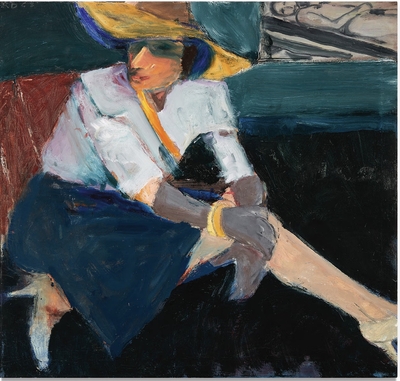 Diebenkorn's version |
The following space shows how artists drew on "Femme au chapeau" through 1948. Jean Metzinger's "Femme au chapeau" (c. 1906), Vlaminck's "Femme au chapeau" (1906) and Kees van Dongen's "Femme au chapeau fleuri" (1905) read as homages, exhibiting little innovation. Yasuo Kuniyoshi's untitled still life (1934) goes furthest afield—seemingly unrelated until, under the compote, a grisaille image of Matisse's masterpiece becomes clear, embellished by grapes Kuniyoshi painted atop Madame's hat.
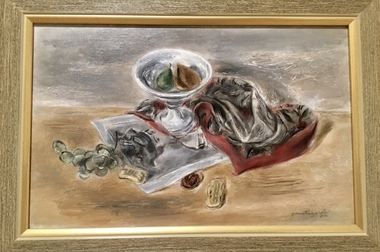 Kuniyoshi's homage |
The last gallery showcases art made since the 1950s. Richard Diebenkorn's "Woman in Hat and Gloves" (1963) depicts his wife, seated cross-legged, in muted blues and grays. She faces in the opposite direction of "Femme," but the shape of her face and pointed nose, and the way her large hat exceeds the picture frame, allude to Matisse. David Hockney, David Park, Wayne Thiebaud, Joan Brown and Mickalene Thomas all painted women in hats, each with a color, a pose, a gaze or another affinity with the Matisse, but none as inspired as Diebenkorn, who created something truly fresh out of his lifelong admiration for the French master. The one sculpture, Rachel Harrison's "Hoarders" (2012), a large amorphous lump, accompanied by a digital monitor, trash can and purple carpet, hints at Matisse's palette, but it looks irrelevant.
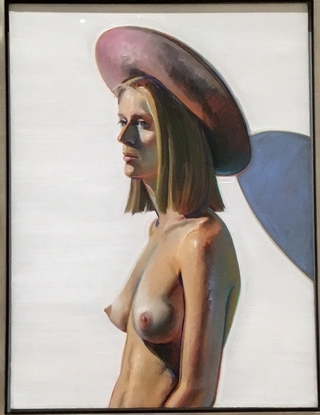 Thiebaud's painting |