



Before dawn on Sept. 8, thieves in southern France broke into what was Impressionist painter Pierre-Auguste Renoir's last home, now a museum, and escaped with two of his paintings. In August, unmasked men absconded with a 200-carat Van Cleef & Arpels platinum and diamond necklace from Vienna's Museum of Applied Arts; thieves stole several Bronze Age objects—some crafted in 23.5 karat gold—from an archaeological museum in Villena, Spain; and criminals took four paintings by the 15th-century master Antonello da Messina from a Sicilian museum. (Estimated combined value: more than $100 million.)
 Wittman |
Coincidence? No, "it's a real uptick," says the art detective Robert King Wittman, a former FBI agent who during his 20-year tenure there recovered more than $300 million of stolen art and cultural property. And there are reasons for it. "Criminals follow the market," he says: They read newspapers and see reports of over-the-top sales at auction houses and of gold surging to record prices exceeding $5,000 an ounce, and "they want to go where the money is." After the theft in Messina, an Italian official cited as possible inspiration the much-noted purchase by Italy of a small painting by Antonello for about $15 million in February.
Equally important, Mr. Wittman says, are the targets themselves: "Criminals are going after easy targets, soft targets, and museums are much softer targets than banks and even some jewelry stores," which frequently employ armed security guards.
Mr. Wittman disparages the common notion that criminals are commissioned to steal renowned paintings for underworld plutocrats who want to look at them secretly on their walls, an idea popularized by the 1962 James Bond film, "Dr. No." As an inside joke, the movie featured a Goya portrait that had been stolen from London's National Gallery in 1961—it's shown hanging in the underground quarters of Dr. No, a mad scientist working for an organized crime syndicate. "I don't think that stealing for hire, when it comes to paintings, exists," Mr. Wittman says. "I've never seen it." Rather, he says, "these thieves are looking for a quick hit." Many are over in minutes.
It's no accident that most cases are taking place in Europe. Even their small museums are rich with treasures, but typically their guards are unarmed, acting more as visitors' guides than protectors of the art. Moreover, Mr. Wittman says, "A lot of the museums in Europe are literally hundreds and hundreds of years old, and they are historic houses, and it's very difficult to rewire internet technology into museums that are hundreds of years old with walls that could be three or four feet thick. It's not conducive to modern technology."
"On top of that," he added in a recent Zoom interview, "the European Union has open borders, which allows criminals to go between countries very easily. So, you have easy escape routes, lack of armed guards, lack of electronic surveillance and electronic response—the sophistication is not there, as it is in many U.S. museums today." (Smaller American museums may not have advanced security systems, but they rarely have high-value objects that lure major heisters—though they are vulnerable to what Mr. Wittman calls "shoplifting.")
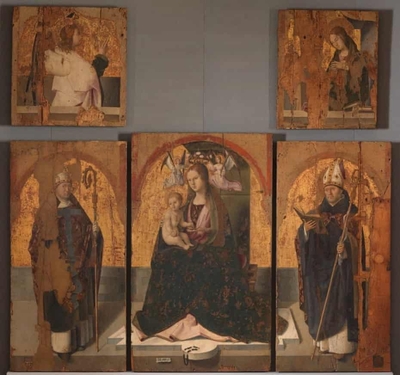 Three panels from this Antonello altarpiece were taken |
He has concluded that the perpetrators (even when they are "good thieves"—that is, not amateurish) are "terrible businessmen" who overestimate their potential returns. Consider the Van Cleef bib necklace, a dazzling Art Deco piece fashioned with 673 diamonds set in platinum that was commissioned in 1938 by Queen Nazli of Egypt. "No one will buy that intact," he says. While precious metals can be melted down and sold anywhere, and jewelry can be broken apart and its stones sold as separate gems in places like Antwerp's diamond market, part of the piece's estimated $6 million value rested in its past ownership. Plus, he added, "a lot of the diamonds are small chips, and I bet that the 6- to 8-carat one in the middle is certified and identifiable" because of its provenance. "They won't get that much money for it," he says.
Famous paintings are obviously even more difficult to monetize. As they are not stealing for hire, criminals may not have a precise plan and are often forced to hold on to—and take care of—precious paintings for years until they can unload them, possibly to shady art dealers who try to sell them to unsophisticated buyers who don't know, or don't care, about provenance. That's where Mr. Wittman's undercover work has come in.
He likes to cite a 2008 recovery in Marseilles, France. Posing as an American art dealer, he gained the trust of the men who had stolen four paintings at gunpoint a year earlier from Nice's Museum of Fine Arts, and lured them into a trap. The thieves had agreed to meet a Frenchman sent by Mr. Wittman to receive the art in exchange for $4.6 million in cash. Instead, they were met by French police, arrested, tried and sentenced to multiyear terms.
Based on his undercover work, Mr. Wittman figures that thieves can expect, perhaps, to get 10% of an artwork's estimated value. "That's what I'd offer them," he says.
That's not much, but neither is the downside. Penalties for art theft are usually low. "Art crime is a property crime, and any type of property crime is not considered a priority by most police departments," he explains. "It doesn't matter if it's a Monet or a Chevrolet at a police department—it's just property." Unless they use firearms—as in Nice—culprits are usually spared steep sentences.
 The necklace stolen in Vienna |
The recent spate of thefts is worrying officials. Europol, the EU's Hague-based law enforcement agency, recently reported that art thieves are increasingly using bolder, more confrontational approaches, wielding firearms, sledgehammers, axes and explosives, and that they may well recognize the low risk involved.
To Mr. Wittman, the answer is deterrence. Museums, he says, have to improve their electronic security systems; vet, annually train and check on all of their employees and volunteers; and make sure their operations manuals and procedures are updated and circulated every year. "You need all three legs, and if any of those legs are not there, you have vulnerability, and that's a bad situation for a museum." For a growing number of institutions, that is proving all too prescient.