Detroit
For more than a century—since her breakout exhibition at Anderson Galleries in New York in 1923—Georgia O'Keeffe (1887-1986) and her art have fascinated the public. Her instantly recognizable flower paintings, desert landscapes, bleached bones and abstractions have won her dozens of museum retrospectives or themed solo exhibitions. She's been paired in shows with artists including Arthur Dove, Henry Moore and Ansel Adams, and examined as an avatar of a stylish personal aesthetic and independent lifestyle. What new angle about her might there be?
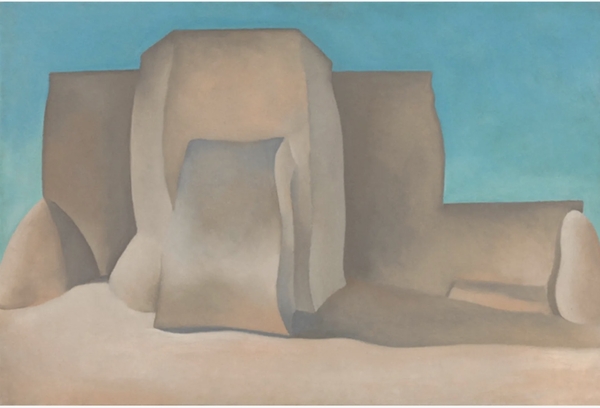 Rachos Church, No. II |
The Detroit Institute of Arts, prompted by the only O'Keeffe in its permanent collection—"Stables" (1932), a straightforward look at a white barn in Canada—has found one: "Georgia O'Keeffe: Architecture." Billed as "the first of its kind to focus solely on the breadth of her vision for the built environment," the exhibition displays 36 paintings of farm buildings, skyscrapers and adobe structures, supplemented by two video projections. A side room outlines her relationships with architects like Frank Lloyd Wright (with whom she exchanged many mutually admiring letters) and industrial designers like Ray and Charles Eames (friends whose chairs she owned).
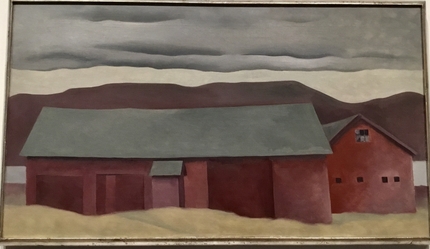 Lake George Barn |
Curated by the museum's Benjamin W. Colman and on view through Jan. 3, 2027, the show groups artworks by the nature of the buildings, offering a fresh vantage point for assessing O'Keeffe. It's a slim premise, overlapping with exhibitions about her landscapes or New York scenes, but Detroit's modest exhibit is aided by its airy display. Several marvelous larger-than-life photographs of her—O'Keeffe's fame has always been amplified by images of her striking appearance, many taken by her husband and foremost promoter, Alfred Stieglitz—add panache.
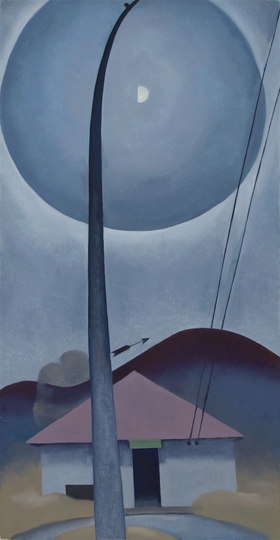 Moonlight |
O'Keeffe spent her childhood on a farm in Sun Prairie, Wisc., and the first gallery, filled with nine paintings of rural structures, recalls those roots. The earliest one, "My Shanty, Lake George" (1922), portrays the building in upstate New York she used as a studio during the many summers she spent there. She painted it in dark hues, with a brownish-red barn, a gray-blue sky and a deep-green mountain. "Ends of Barns" (1922) has truer reds and blues, but it's also dark in tone. At the time, critics were characterizing O'Keeffe's flower pictures as feminine; in response, she said, she would create "those dismal-colored paintings like the men." They are more moody than dismal, with no trace of the exuberance in her flowers—with one exception: In "Spring" (c. 1923-24), O'Keeffe painted bright, blooming lilac trees behind Stieglitz's darkroom shed.
They are also something else. Straight lines, rather than her usual curves, abound. And while not completely flat—O'Keeffe exposes grime on the white walls of "Stables" and shadows under the eaves of "Lake George Barn" (1929), for example—these barns are not the detailed ones of realist artists like, say, Grant Wood. O'Keeffe simplified them, exploring geometric shapes and planes of color. Some, like "Red Barn in Wheatfield" (1928), edge toward abstraction.
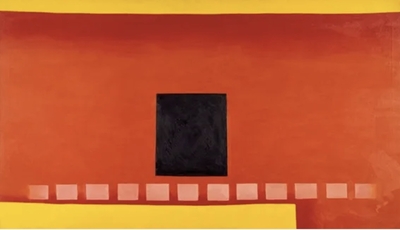 Black Door with Red |
In the 1920s, while O'Keeffe was living in Manhattan, she began painting highrises, often looking up from below or down on the city and across the East River from her quarters in the Shelton Hotel. They, too, are simplified, but harder-edged than her barns. And although this section contains two dazzling works, "City Night" (1926) and "Brooklyn Bridge" (1949), it's the weakest—her gray city views of buildings against the skyline seem to be dutiful, rather than inspired.
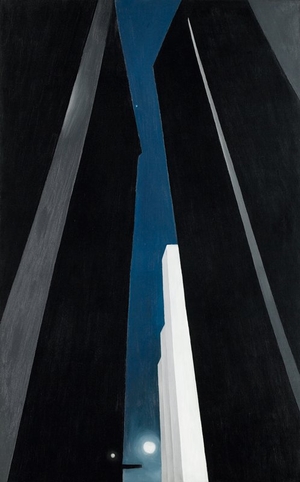 City Lights |
O'Keeffe was quite distinctive—and here at her best—in her paintings of adobe buildings. Living in New Mexico, enthralled by its unique light, she painted pueblos, churches and her house at Ghost Ranch, where she spent many summers. "Taos Pueblo" (1929/1934) depicts the five-story dwelling that has been inhabited for more than a thousand years—a major tourist attraction—behind an extensive dirt foreground, as if O'Keeffe were respectfully keeping her distance. With its deep-blue sky populated by elongated clouds, her lovely, placid "Front of Ranchos Church" (1930), which she called "one of the most beautiful buildings left in the United States by the early Spaniards," foreshadows the acclaimed cloudscapes of her later years.
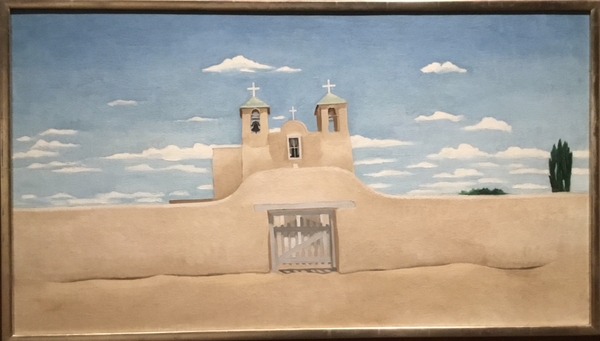 Front of Ranchos Church |
Two outstanding works, "Ranchos Church No. 1" and "Ranchos Church, No. II, NM," both from 1929, are soft in line and earthy in color. They show O'Keeffe's favored back view, and the beguilingly spare, almost biomorphic forms of its massive adobe buttresses, along with the subtle shadows, that make that completely understandable.
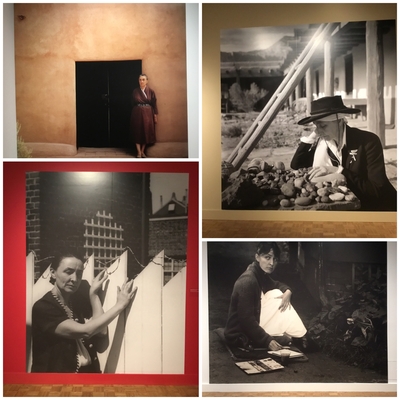 The exhibition's final section features eight near-abstract paintings (dated from 1948 to 1956) of the wall, the door, the sky and sometimes the foot path beside the patio at her home in Abiquiú, N.M., part of a series in which O'Keeffe explored the shift in colors and lighting at different times of the day. In them, she occasionally modified her perspective and once said, "I'm always trying to paint that door—I never quite get it . . . It's a curse." These works, meditations on a space where she spent much time, share some kinship with those of the Abstract Expressionists and Color Field painters of the era.
"Georgia O'Keeffe: Architecture" is as much about the importance of place as it is about buildings. In each locale, O'Keeffe's palette and even the vibrancy of her works changed, and in each one her abiding originality, power and finesse as an artist are unmistakable.