



Philadelphia
American art—definitionally—has had a checkered existence. Early artistic attempts were largely derivative of European art; Native American and folk art weren't taken seriously until recent decades, and decorative objects were deemed "industrial arts" for a long time. Not until the 19th century, with the birth of the Hudson River School, could the U.S. claim a native-born style and, even then, only in the mid-20th century, with the advent of Abstract Expressionism, did American art gain worldwide recognition.
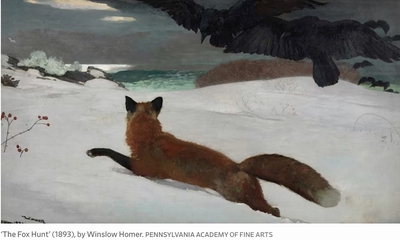 For the nation's 250th anniversary, the Pennsylvania Academy of the Fine Arts and the Philadelphia Museum of Art are saying goodbye to all that. In a joint exhibition titled "A Nation of Artists," they explore the subject using similar themes—like labor, westward expansion and global exchange—but different approaches.
At the Philadelphia Museum, an early wall label declares "artists are everywhere among us." Swooping up paintings, sculpture, silver, furniture and everyday objects made between 1700 and the 1950s, it vastly expands the definition of art and mixes disparate objects together in loosely chronological galleries. Butter molds meet oil paintings.
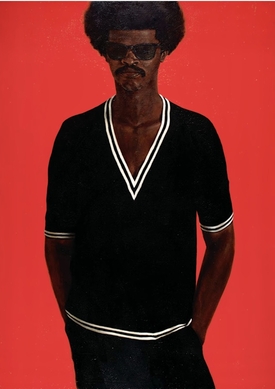 Hendricks |
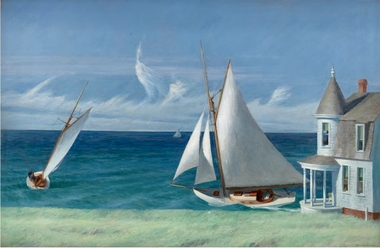
At both venues, the curators—Kathleen A. Foster, Alexandra Kirtley and Julia Hamer-Light at the museum and Lea Stephenson and Leah Triplett at the academy—supplemented their collections with about 120 artworks lent by John S. and Leigh Middleton. They include notable paintings like "George Washington at Princeton" (1779) by Charles Willson Peale, "The Shore of the Turquoise Sea" (1878) by Albert Bierstadt and "The Lee Shore" (1941) by Edward Hopper; they push the number of works in the museum's exhibition to about 750 and at the academy's to more than 280. It's a lot, but the shows run through July 5, 2027 and Sept. 5, 2027, respectively, so there's plenty of time to take it all in.
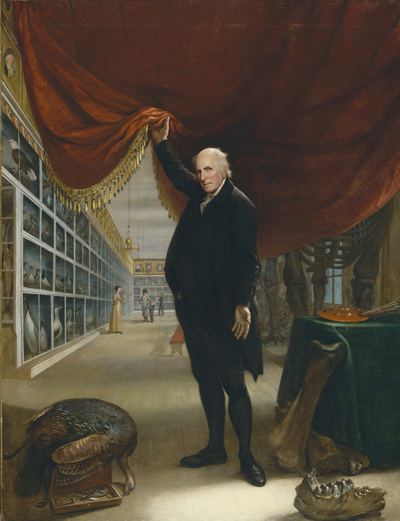 Peale and his museum |
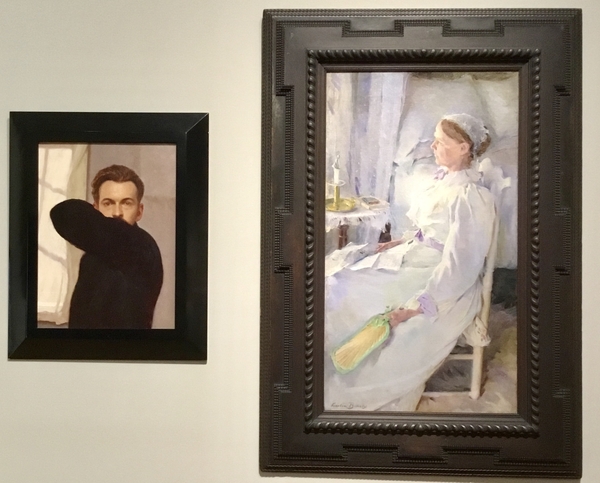
While some surrounding galleries don't jell as well—partly because their themes bleed into one another—they nevertheless present intriguing arrays. One section on portraits juxtaposes Bo Bartlett's confrontational, meticulous "Self Portrait" (1996), him posed in black near a sunlit window, arm raised across his chin, with Cecilia Beaux's brushy "New England Woman" (1895), also in a sunlit room, but wearing white, her arm making the opposite diagonal. Another theme casts works by Americans who studied, lived or traveled abroad, such as Benjamin West, here in "Death on a Pale Horse" (1817), and John Singer Sargent, with "In a Garden, Corfu" (1909), as international in style, not strictly Euro-derivative.
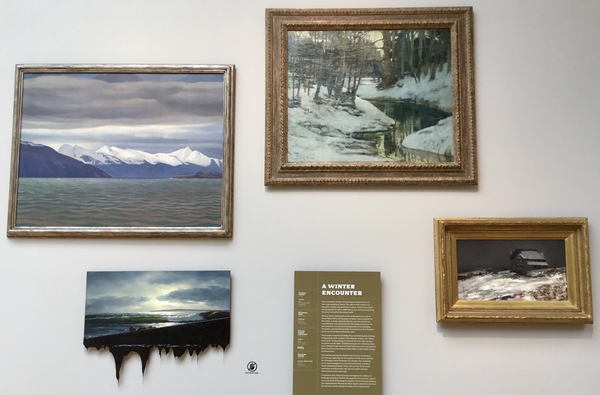
The densely hung new galleries, containing post-1840s works, remind visitors that the museum has roots in the 1876 Centennial Exhibition, opening afterward as the Pennsylvania Museum and School of Industrial Art. Furniture, vessels, porcelain, silver and a sampling of household goods populate a display that's nonhierarchical.
A typical gallery, headed "Prosperity, Abundance, and Inequity 1840-1860," presents a fancy white marble mantelpiece, elaborate furniture, Martin Johnson Heade's lush "Orchids in a Jungle" (c. 1871-74) and Severin Roesen's lusher "Flower Still Life With Bird's Nest" (1853). Yet a central vitrine holds a plain stoneware jar (1859) made by an enslaved black man, David Drake, that's inscribed with a biblical verse suggesting universal salvation.
A nearby gallery, hung salon-style, considers the theme of "Nature and Nation." Painters including Bierstadt, Cole, Frederic Edwin Church, Fitz Henry Lane and Robert Seldon Duncanson provide a realistic wonderland of America's outdoors, often in panoramas. It's a stellar display.
 Hopper |
To many, American art in Philadelphia means two works by the city's own Thomas Eakins—the hyper-realistic "The Gross Clinic" (1875) and "The Agnew Clinic" from 1889. They currently hang at PAFA and at the museum, respectively. But "A Nation of Artists" demonstrates that Philadelphia, sometimes called "the birthplace of America," is a cradle of American art, too.