Gloucester, Mass.
In the 1930s and '40s, three friends—all artists, one almost a generation older than the others—spent their summers here, sketching and painting the picturesque environs of America's oldest continuously operating seaport. They are known for very different styles: Milton Avery (1885-1965) for his colorful, flat, figurative scenes; Adolph Gottlieb (1903-1974) for his abstractions, especially those featuring a sun-like orb over a burst of color; Mark Rothko (1903-1970) for his color-block paintings evoking emotion, not image.
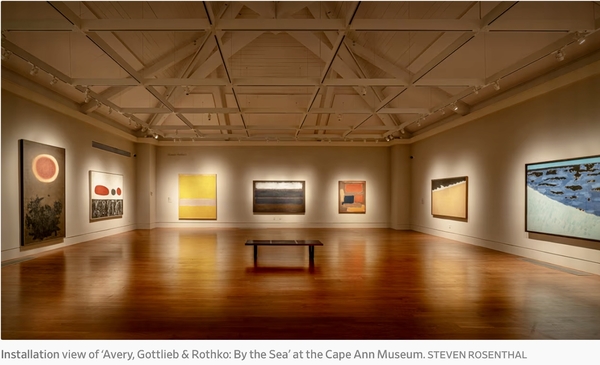
Even serious art-lovers might fail to see links among them. Yet as "Avery, Gottlieb & Rothko: By the Sea" at the Cape Ann Museum reveals, their friendships, their summers and their mutual admiration critically influenced their artistic paths. By the time visitors reach the exhibition's last gallery in this newly renovated museum, which reopened June 30 after a 20-month upgrade, they can't help but observe the connections.
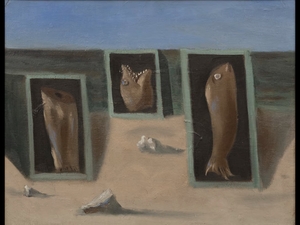 A crate painting by Gottlieb |
Credit for this surprising exhibit goes to Eliza Rathbone, chief curator emerita at the Phillips Collection in Washington—which has long associations with all three artists—who decided to bring to light a story that to some had been known, but never truly shown. She dug into troves of paintings and drawings, some owned by family members, and chose more than 80, many of which have never been displayed in public, that make the point.
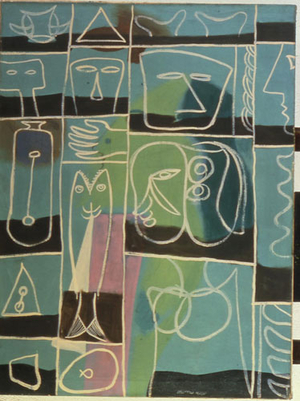 Gottlieb's "Mariner's Incantation" |
The exhibition, which runs through Sept. 27 and then moves to the Phillips, follows both a chronological and thematic path. It starts soon after Avery initially arrived in Gloucester for the summer of 1921. His "Gloucester Dawn" (c. 1921) and "Untitled (Harbor Scene)" (c. 1921-25) exhibit impressionistic tendencies, perhaps inspired by Monet. By the end of the decade, though, he'd shifted to flatter, less brushy scenes.
Later that decade, Avery befriended Rothko and then Gottlieb, and by 1932 all three were summering in Gloucester, spending their mornings sketching or painting the harbor, the wharfs, the sea, the beach and the bathers. In the evenings, they discussed their work, with Avery as mentor at first.
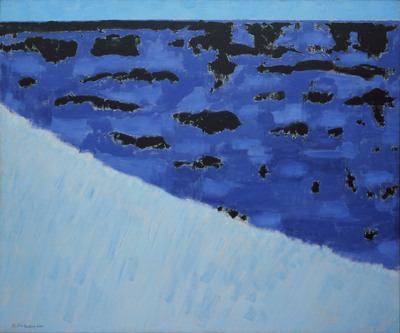 Avery's "Sea Grasses and Blue Sea" |
Judging by a wall of Avery's 1930s beach scenes—lighthearted sketches and watercolors of people enjoying the ocean, with one even called "Untitled (Lazy Afternoon)"—he clearly moved to a more modern mode, deploying loose lines and bright colors.
Rothko, meanwhile, also painted bathers—a little clumsily, like Cezanne's. He also created several small, realistic earth-toned scenes of the town, such as "Untitled (Wharf, Gloucester, Massachusetts)," from 1934, which portrays fish processing on the waterfront. Gottlieb seems even more drawn to the industrial aspects of the port. His "Harbor Scene Gloucester?" (c. 1934); "Rockport" (c. 1936), made in the less gritty town up the Cape; and "Wharf in Gloucester" (undated) look almost somber. Rather than people, his focus is on shells and other sea detritus, which he arranged in discarded crates.
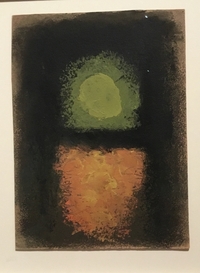 Avery's "Moonlit Sea" |
These crate paintings lay groundwork for Gottlieb's pictograph series, which would become a signature for him. In "Mariner's Incantation" (1945), for example, he placed simplified images of fish, faces, a hand and nautical symbols in a blue-green grid—a step toward abstraction that blends in Surrealism. Rothko also begins to flirt with Surrealism—which becomes more pronounced in his output as the tragedies of World War II unfolded. His works here, like "Iphigenia and the Sea/Horizontal Phantasy" (1943) and "Abstract Composition" (1944), place the sea as a backdrop for his musings on myth and the unconscious. Such overt connections with Gloucester would soon fade.
Already established by the 1940s, Avery's work grows simpler, more expansive, flatter and with larger color blocks, but his images remain tethered to the real world.
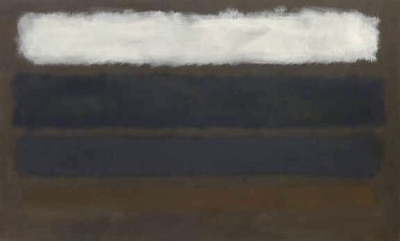 Rothko's "No. 14 (Horizontals, White Over Darks)" |
In "Lone Rock and Surf" (1945), he provides only the essential elements of a scene—frothy white waves crashing against a black rock, with a stripe of pink for the sky. Edging toward abstraction, his "George Constant Fishing" (1945) also strips the image down to its necessities. Constant, standing on a striped rock, consists of two color patches; the rest is largely blue sea, topped by a light-gray strip of sky.
Everything comes together in the final gallery, where each artist commands a wall of paintings. The links, often subtle, seem intuitively clear. Avery once said he wanted to create big works "like the Abstract boys"—and he has. "Sea Grasses and Blue Sea" (1958), at 5 feet across, presents two triangular blocks of different blues, one daubed with black, beneath a turquoise strip of sky. "Black Sea" (1959), at more than 5 1/2 feet wide, shows an expanse of peach sand, bubbling white water and a sliver of deep-sea black. A small work, "Moon Lit Sea" (1959), floats a greenish sphere over its orange reflection in a black background—shades of both Gottlieb and Rothko.
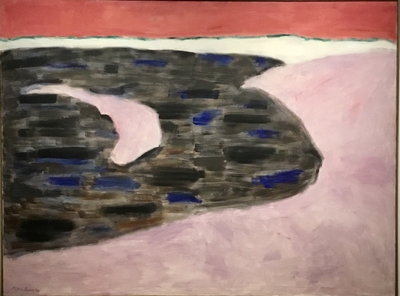 Avery's "Dunes and Sea" |
On Rothko's wall, "No. 14 (Horizontals, White Over Darks)," from 1961, might be a darker version of "Black Sea," while "No. 20" (1949) picks up the architecture of Gottlieb's crate paintings and pictographs. And suddenly Gottlieb's "Under and Over" (1959), a quintessential burst painting with a glowing red orb over black splotches, reads like some of Rothko's dark color-block works. Gottlieb's bright "Blue at Night" (1957) imagines a seascape.
All three men are now intently focused on color and simple forms, an interest developed, refined and tailored to their own visions in Gloucester, a place that affected the rest of their careers and a period of American art.