



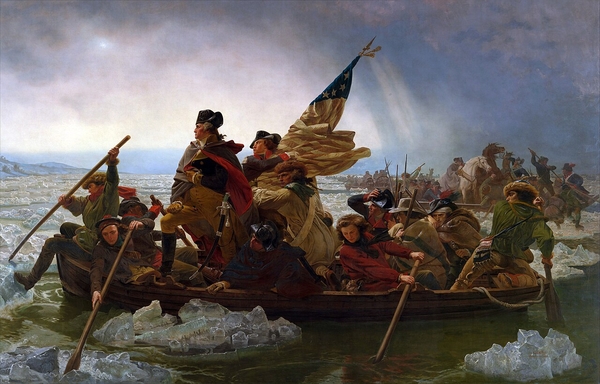
On Christmas night, 1776, less than six months after the Declaration of Independence was proclaimed and despite freezing temperatures, driving rain and a strong nor'easter, George Washington led a flotilla of soldiers across a frozen river to a surprise victory the next day over the British near Trenton, N.J. It was this epic moment, which buoyed morale and saved the Revolutionary War from collapse, that Emanuel Leutze memorialized in "Washington Crossing the Delaware" (1851), in New York's Metropolitan Museum of Art. Gray clouds darken the sky, but Leutze bathes Washington in light, depicting him as an unflinching leader of a squad of men that purposely includes a Native American and a black man.
 Leutze |
America's artists have always chronicled, celebrated and criticized the nation's historical events, values, achievements and faults in paintings—abetting our understanding of our history.
George Caleb Bingham created several works about the democratic process, none more renowned than "The County Election" (1852) at the Saint Louis Art Museum. Bingham's crowded scene portrays the messiness of democracy: His voters, exclusively white men but of various means and demeanor, include some engaged in serious conversation, others hunched over a newspaper and some who are inebriated; one would-be voter (said to be an immigrant) is swearing an oath; another is perhaps trying to buy votes. Still, portraying the process as essential, Bingham casts the painting in glowing light and crowns it with a blue sign that says "The will of the people the supreme law."
 Church |
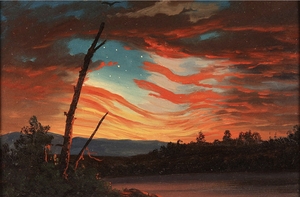
Frederic Edwin Church's "Our Banner in the Sky" (1861), at the De Young Museum in San Francisco, also served as an emotion-stirring political statement. Soon after the start of the Civil War, Church turned the atmospheric effects of a rising sun, striated clouds, and stars peeking through a patch of sky into a tattered Union flag. Grounded by a barren tree serving as a flagpole, the standard flies over a war-torn landscape. Like Bierstadt, Church was not just stoking patriotic fervor, but also evoking divine providence as favoring the North's cause.
 Beard |
 Demuth |
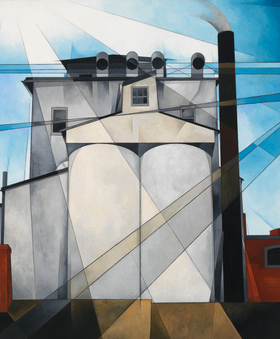
Charles Demuth created a different metaphor for American industry. With "My Egypt" (1927) at the Whitney, he equated the nation's factories and industrial might with the monumental constructions of Egyptian pharaohs. Rendered in ultra-realistic Precisionist style, his steel-and-concrete grain elevator dwarfs its surroundings, while crisscrossing rays of intense sunlight link it to the heavens.
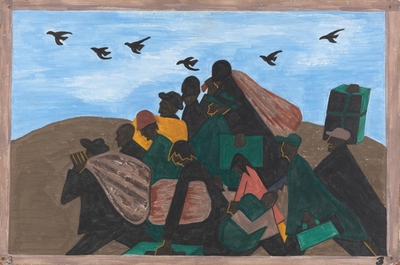 Socioeconomically, the U.S. was fast-changing, its pace accelerated when, from the 1910s to the 1970s, six million black Americans fled racial violence and constraints on their liberty in the Great Migration. "From every southern town migrants left by the hundreds to travel north" (1940-41), in Washington's Phillips Collection, from "The Migration Series," a 60-panel narrative cycle of paintings by Jacob Lawrence that was split with the Museum of Modern Art, captures this exodus in a simple but touching way. His figures, generic, without details, carry all they own in sacks on their backs, hoping that when their journey concluded they would find a better life. Some found labor, feeding industry's needs; others settled into a hopeless life in the underclass. Together, they changed the course of American history.
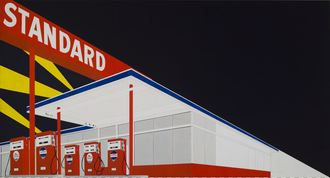 Ruscha |
By the mid-20th century, Hollywood boomed—beyond dollars. It also spread celebrity culture, here and abroad. Andy Warhol paid attention, creating "Marilyn Diptych" (1962), in London's Tate Modern. What better way to comment on film-star fixation than to repeat the image of Marilyn Monroe, drawn from a publicity photo, 50 times? He placed two panels of 25 images each side by side, half colorized and half black and white, alluding to religious diptychs of the past. It both commented on and encouraged celebrity culture.
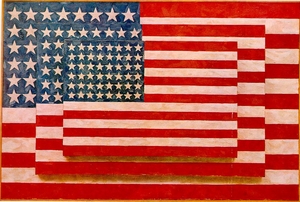 Johns |
And as we celebrate the 250th anniversary of the day the founders courageously decided to throw off despotism, isn't that the essence of America?