Washington
"Grandma Moses: A Good Day's Work" at the Smithsonian American Art Museum honors the career of Anna Mary Robertson "Grandma" Moses (1860-1961) using words she chose to summarize her contented, never-idle life. Yet maybe one of her paintings provides a better title: "Grandma Moses Goes to the Big City" (1946). It depicts her in a black dress, ready to depart from her home in Eagle Bridge, N.Y., in November 1940, for Manhattan, where Gimbels department store was displaying her works. But only now, many decades later, is a large, urban museum devoting a major monographic exhibition to her work.
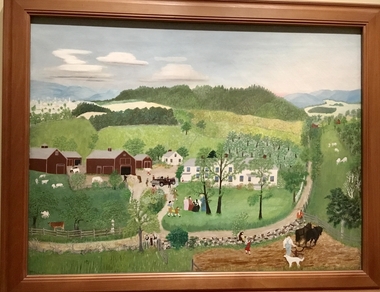 Grandma Moses Goes to the Big City |
Moses's folksy scenes of her farm community at work and at play have charmed the public, attracted collectors, adorned Hallmark cards, and—for a while—made her one of the country's most famous artists. But if she is a delightful, gritty inspiration to some, Moses has always been an overrated "primitive" kept aloft by a winning backstory to others, including many art-world gatekeepers.
"A Good Day's Work" sets out to recast Moses as more complicated than the cheerful, childlike images her name conjures and as a legitimizer of self-taught art. At age 78—just two years before the Gimbels show—Moses had swapped her life of farm work and domestic chores for the brush and easel, turning to painting after arthritis ended her endeavors in embroidery. Seeing her paintings in a drug-store window in Hoosick Falls, N.Y., a collector bought the lot, sought her out for more, took the artworks to New York, and two years later, after many rejections, found a willing dealer in Otto Kallir, the owner of the Galerie St. Etienne. He gave her a show called "What a Farm Wife Painted" and, the next month, she was on her way to Gimbels and fame.
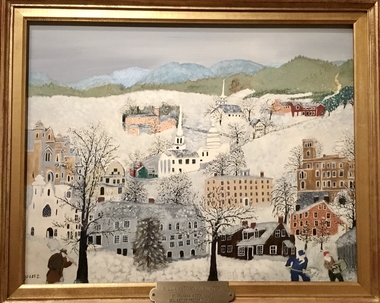 Williamstown in Winter |
For "A Good Day's Work," on view through July 12, Leslie Umberger, the museum's curator of folk and self-taught art, and Randall Griffey, its former head curator, have gathered 88 paintings and various ephemera to make their case. In the first gallery, they've hung works depicting disastrous events, not placid landscapes—"The Burning of Troy" (c. 1939), for example. Using a 1939 newspaper account, Moses pictured an 1862 fire that ravished the city in upstate New York. It evinces her hand in its flat figures racing with buckets toward a burning bridge. "A Fire in the Woods" (1940 or earlier) also conveys her familiarity with catastrophe. Six other bleak works hang nearby, including "A Storm Is on the Water Now" (1947), where winds bend the trees, clouds threaten, and two horses flee the impending deluge.
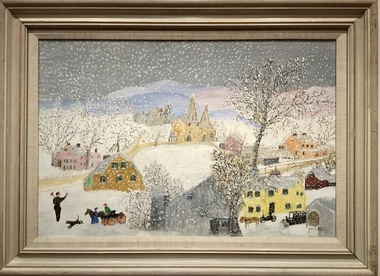 Get Out the Sleigh |
Moses's life forms the exhibition's spine, and it was a rather hard one. She had little formal schooling, and at age 12 was sent out to be a hired girl, never to return home—or stop working—again. Five of her 10 children died in infancy, and both her husband and a grown daughter predeceased her. But she had learned early on to "take the bitter with the sweet," remain positive and keep busy. In her final decades, she completed more than 1,600 paintings.
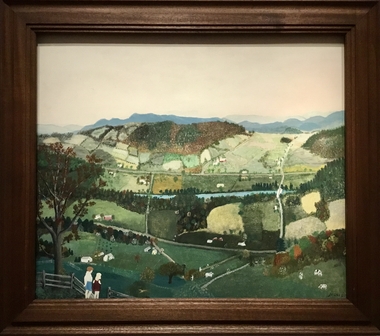 Cambridge Valley |
Moses was inspired to create both from her memories and from a trove of postcards, magazines, prints and other sources she kept in her bedroom, where she worked on a small easel propped on a table. Viewers see her early years in Washington County, N.Y., with "Childhood Home of Anna Mary Robertson Moses" (1942), a broad, simple landscape. She recalls her days living in Virginia, where she and her husband had moved in 1887 to answer the call for skilled labor in the war-ravaged South, in the evocative "Apple Butter Making" (1947). Set against the distant Blue Ridge Mountains, it depicts a favorite Southern activity—akin to her widely admired maple-sugaring paintings set up north—embellished with details like the tiny rocking horse on her front porch. She recounts her return to upstate New York in "Moving Day on the Farm" (1951), an emotional moment she had dreaded.
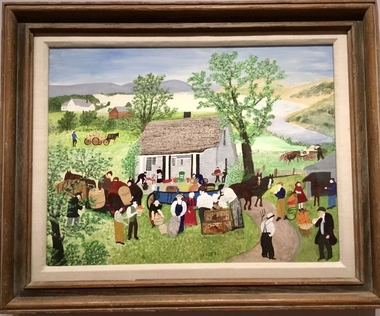 Moving Day |
There's little discernible time continuum in Moses's works, and her skills wavered, too. Pre-1942, she struggled to incorporate details into her sweeping landscapes. But after noticing the way a convex mirror compresses space, she began flattening her landscapes, leaving less distinction between foreground, middle and background, or using a slightly elevated vantage point to see farther out—allowing more complex paintings. "Cambridge Valley" (1942) was a pivot: It's a broad view implanted with plenty of details, like the tiny houses and horses dwarfed by two onlookers in the foreground. Other examples: "A Beautiful World" (1948), "Williamstown in Winter" (1948) and "Out for Christmas Trees" (1946), the last two being among her many enchanting, highly desired snow scenes (which she sometimes sprinkled with glitter).
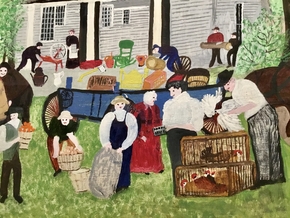 Detail from Moving Day |
Moses was clearly a keen observer of nature. Yet while humans seem to be a weak spot (her figures are almost always flat, nearly featureless, repetitive and sometimes ghostly white), her best pictures portray busy people within those wide scenic views.
As she aged, Moses's style grew looser, probably a result of her arthritis. But she kept working, completing "The Rainbow" (1961) after her 101st birthday. With its sign of hope, it's a statement of her lifelong philosophy, a reason she has attracted a popular following, and an ode to life.
Grandma Moses: A Good Day's Work
Smithsonian American Art Museum, through July 12