San Francisco
They were ancient Italy's first great engineers, ambitious road-builders who drained land for development and showed the Romans how to build their famous aqueducts. They pioneered winemaking, loved banquets and included women in public life. They saw messages from the divine in thunder and lightning, bird flight and the entrails of sacrificed animals. And they developed an alphabet that evolved into the Roman letters used throughout Western civilization today.
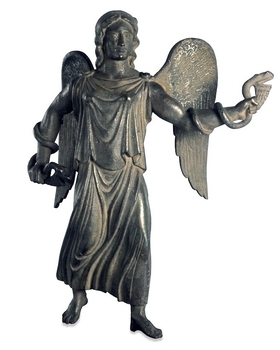 Vanth |
They were the Etruscans. Culturally sophisticated, they were indigenous to what is today Tuscany and parts of central Italy and they flourished from the ninth to the first centuries B.C., until the Roman Empire absorbed their city-states one by one. Ever since, the Etruscans have been overshadowed in history books by the Greeks and Romans—and at many museums that mix in their artifacts with other ancient objects.
"The Etruscans: From the Heart of Ancient Italy" at the San Francisco Legion of Honor museum aims to rectify that. Self-proclaimed as "the most comprehensive Etruscan exhibition ever staged outside of Italy," the exhibition showcases about 175 items, from intricate metalwork to lustrous pottery to a remnant of Europe's oldest extant book. Organized and arranged thematically by Renée Dreyfus, the museum's curator of Ancient Art, it will be on view through Sept. 20.
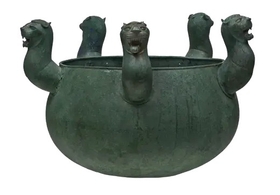 The lebes with lions |
The show starts with an 11-minute video, which includes aerial views of the round "tumuli" mounds that shielded Etruscan tombs. It functions not only as an introduction to Etruscan culture but also as a link to the first, core gallery. There, in a white circular space, visitors will see a selection of grave goods, which make up most of the surviving Etruscan artifacts. At its center sits a grand bronze lebes (675-650 B.C.), or cauldron, verdigris with age, whose five lion protomes bare their tiny teeth. Nearby, another lebes (second quarter, seventh century B.C.), with snake protomes and made of ornately embellished silver gilt, and an elaborately decorated bowl (675-650 B.C.) with Egyptian and Near Eastern imagery together illustrate two themes of the exhibition: Etruscans traded and exchanged customs with other Mediterranean peoples and they were master metalworkers.
More proof of the latter comes in an exquisite gold bowl (700-650 B.C.), an example of granulation—a difficult technique that requires seamless soldering of minuscule gold beads into decorative patterns, here chevrons, scrolls, meanders and more. Granulation dates to Mesopotamia, but the Etruscans elevated the practice, using granules as small as 0.14 millimeter in diameter, one-seventh the size of those used by Mesopotamians and Egyptians. The shimmering jewelry displayed in later galleries supplies, well, more glitter.
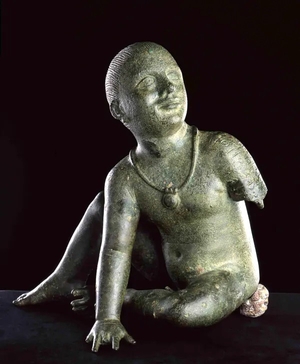 The bronze boy |
Etruscan bronzes, too, can be detailed and (perhaps inadvertently) charming. A seated boy (late fourth-third century B.C.) with an enigmatic smile and slicked-back hair torques his naked body toward the viewer; he is a votive offering to the deities engraved on his arm. An appliqué of the winged sun god Usil (500-475 B.C.) poses imposingly, with oversize arms and hands hanging at his sides (like the Hulk). A statuette of the winged goddess Vanth (425-400 B.C.), her arms entwined with snakes, gazes into the distance and, because she guided the dead, perhaps to the underworld.
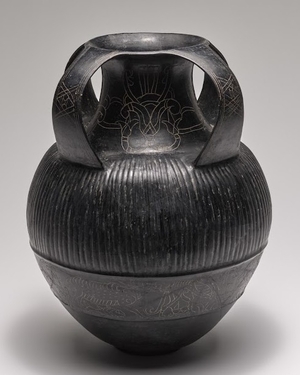 Ribbed Amphora |
The Etruscans are also known for their bucchero ceramics, pottery they made with an inventive process that turns red clay into glossy black pieces, which they sometimes incised. "The Etruscans" unveils about 20 examples, many noteworthy for their shapes or designs: a drinking cup resembling a bent leg (550-530 B.C.); a ribbed amphora (625-550 B.C.) ringed by a frieze featuring fantastical animals; and the "Calabresi pyxis" (650-600 B.C.), a small, round food box incised with fan and wave designs and decorated with four ram protomes.
Two important items aren't much to look at, but they reveal Etruscan spirituality and worldliness. "The Liver of Piacenza" (end of second-first century B.C.) recreates in bronze a sacrificed sheep's organ. Priests used this odd object, divided into zones inscribed with the name of a god, as a teaching tool: In a sacrificed animal, departures from the liver's usual features were viewed as messages from deities. And the "linen book of Zagreb" (mid-third century B.C.), likely owned by an Etruscan living in Alexandria, Egypt, recorded the expected daily prayers and rituals. At some point, it was torn into strips and used to wrap a mummy. Rediscovered in the 19th century, it documents how Etruscans adapted letters borrowed from the Greeks (who borrowed from the Phoenicians) in order to facilitate trade.
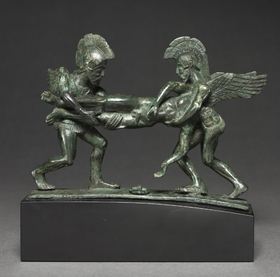 'Sleep and Death' cista handle |
The final gallery offers both reality and hope. Its dominant object, a bronze sculpture of the god Veiovis, dates to the first century A.D., after Etruscans became Roman citizens. With lifelike features, including muscles and veins, it's finer aesthetically but less distinctive than earlier pieces, and suggests the denouement of their separate culture. But near the exit, three bronze votive offerings (end of third-second century B.C.), including a sleeping swaddled infant, signal that Etruscan culture may have persisted longer than assumed: The votives were recently discovered at a site in Tuscany that remained active into the fifth century A.D. "The Etruscans" deftly—and rightfully—elevates our knowledge of this ancient civilization, and the finds suggest that there's still more to learn about its presence and influence.