



Fort Worth, Texas
Contrary to much popular belief, all art is not political. But in the first half of the 20th century—when Germany was experiencing rapid industrialization and militarization; the rise of nationalism and socialism; the defeat of World War I; the creation and swift fall of the liberal Weimar Republic; and a totalitarian Nazi regime that enforced its artistic taste by persecuting, exiling, even killing artists—German art certainly was.
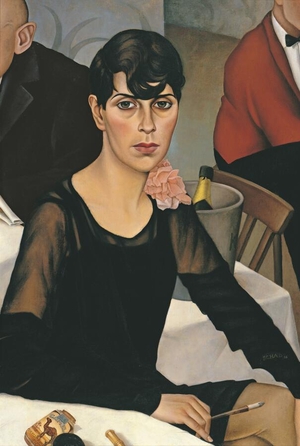 "Sonja" |
"Modern Art and Politics in Germany 1910-1945: Masterworks From the Neue Nationalgalerie, Berlin," at the Kimbell Art Museum, tries to rectify the situation—and unavoidably prompts reflection on political developments around the world today. Curated by Irina Hiebert Grun and Dieter Scholz, from Berlin, and George T.M. Shackelford, of the Kimbell, this exhibition of more than 70 artworks captures anxious times in various styles and subjects. It's enlightening, not only for offering stark commentary but also because it introduces artists unknown in America, even to many art historians.
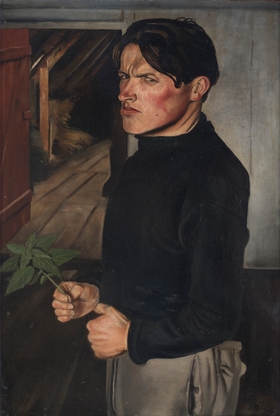 Querner's Self-Portrait |
Arranged chronologically, the six themed galleries begin with the unease of Expressionism. Kirchner, whose name is synonymous with the movement, defines it with the crude brushstrokes, abnormal colors and psychological intent of his "Self-Portrait With a Girl" (1914-15). Other works more than hold their own, including Gramatté's "Portrait of Rosa Schapire (1920), whose piercing eyes and uncomfortable pose betray her position as a wealthy, Jewish socialist, and Max Pechstein's brazen, Gauguin-like nude, "Seated Girl" (1910).
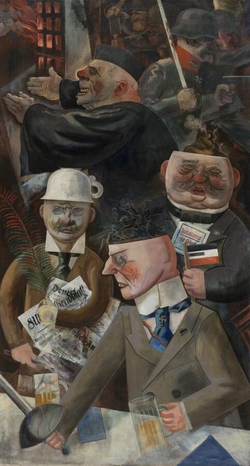 Grosz's "Pillars of Society" |
Unsurprisingly, nationalists preferred German art, but several dealers actively promoted modern art by foreign artists anyway, seen here in a mildly Cubist "Woman Sitting in an Armchair" (1909) by Pablo Picasso, a surrealist landscape (c. 1945) by Giorgio de Chirico, and a lovely pair of loosely painted portraits of architect Adolf Loos (1909) and dancer Bessie Bruce (1910) by the Austrian anti-fascist Oskar Kokoschka. These international styles rankled the authorities, yet they helped shape the work of German artists. Hannah Höch's glowing surrealist painting "The Mosquito Is Dead" (1922); Otto Möller's "City" (1921), an abstract mélange of Berlin's ads, street signs and traffic; and Klee's nightscape "The Ships Departing" (1927) rank among the standouts.
The exhibition climaxes in the penultimate gallery, "Politics and War." George Grosz's acidic "Pillars of Society" (1926) satirizes corrupt, piglike officials, military men, the press and a minister, in a barroom scene dominated by an earless judge. It, along with Georg Kolbe's oversize bronze sculpture "Descending Man" (1939-40), an idealized, nude, striding Aryan, would dominate this, the largest of the galleries, were it not for Horst Strempel's "Night Over Germany" (1945-46). An altarpiece-like triptych, it somberly depicts life under the Nazis—citizens hiding from bombs, a concentration camp, a terrorized Jewish family, and in the small bottom panel a hint of the underground resistance. It was stashed in storage for decades.
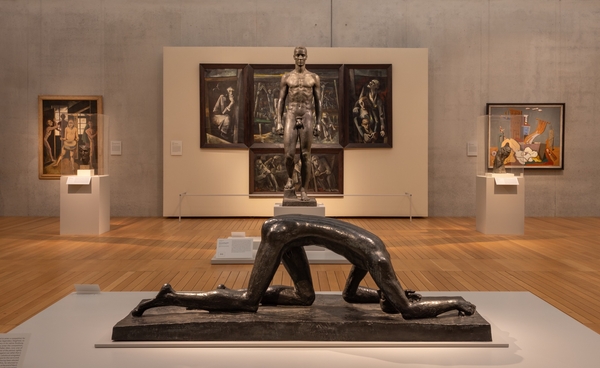 Penultimate gallery, Strempel painting in background |
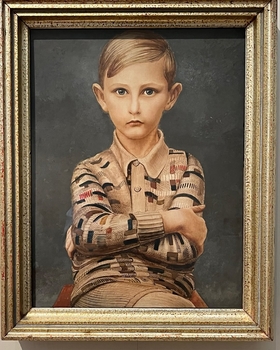 Kurt Günther's portrait of a boy |