



Toledo, Ohio
Renowned in her time, with her paintings in high demand, Rachel Ruysch (1664-1750) has nonetheless been largely ignored by museums. She has never had a major monographic exhibition, not even in her hometown of Amsterdam. Undeniably, it could be a challenge: Ruysch almost exclusively painted still lifes—the main genre open to female artists at the time—and almost always floral arrangements. Roomfuls of Ruysches, no matter how exquisite, might feel like a florist's shop.
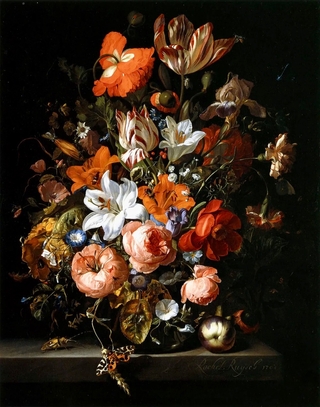 "Flowers in a Glass Vase" |
Here, a virtuoso painting, "Flowers in a Glass Vase" (1704), opens the exhibition. With
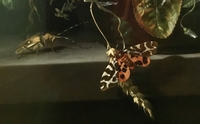 Detail |
Ruysch's career had started nearly a quarter-century earlier. Born to Frederik Ruysch, an esteemed botanist and anatomist, and Maria Post, daughter of a famed architect, Rachel was sent in her teens to study with celebrated flower painter Willem van Aelst. Her earliest dated work, "Swag of Flowers and Fruit Suspended in Front of a Niche" (1681), with its glistening grapes and fluttering butterflies, demonstrates her talent at age 17. "Flower Piece" (c. 1682) illustrates a practice she learned from Van Aelst: to give each flower its own space.
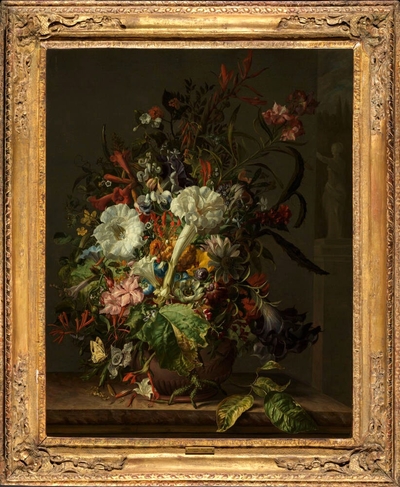 This painting depicts 36 species. |
Ruysch's father was critical to her career. They lived in an age of intense interest in natural history, including a craze to collect plant and animal specimens from all over the world. As a youngster, Rachel spent time in Frederik's laboratories, helping him catalog his species. In a gallery full of botanical and zoological illustrations, books (including some her father published) and preserved specimens, visitors enter Rachel's artistic milieu. She probably made many drawings, though only one survives, "Surinam Toad" (c. 1688)—a female hatching baby toads.
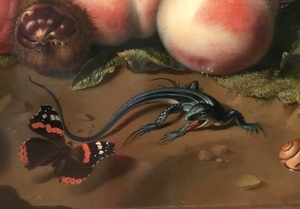 Lizard on attack detail |
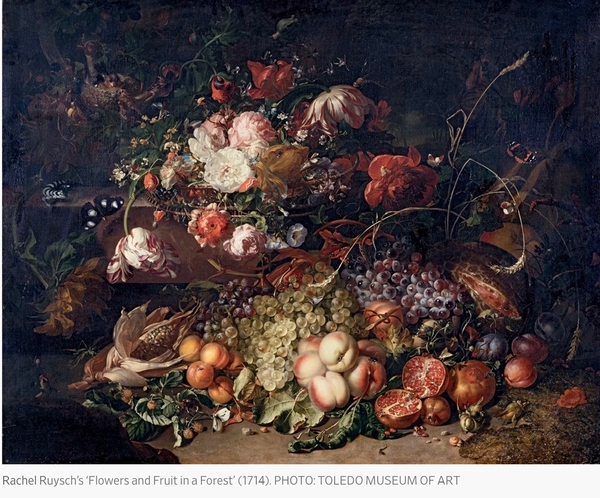
Even more important, Ruysch imbued her paintings with dramatic little slices of life, giving them an uncommon dynamism. Her flowers shine, but they also wither and decay. More than once, she portrayed an energetic lizard closing in on a butterfly for a meal—as in "Still Life With Fruit and Flowers" (1714) and "Still Life With Fruit" (1711). Both "Still Life With Fruit, Bird's Nest, and Insects" (1716) and "Still Life With Fruit, Flowers, Reptiles and Insects on the Edge of a Forest" (1716) depict a striped lizard enjoying the contents of a bird's egg. Ruysch also placed bees, beetles, snails, caterpillars and more in her works.
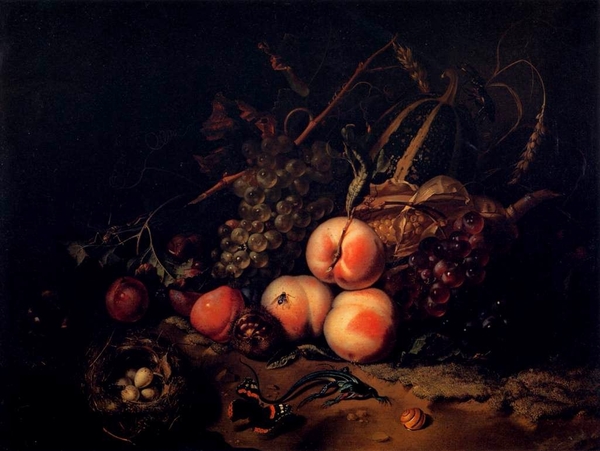 Given to Cosimo, now at Uffizi |
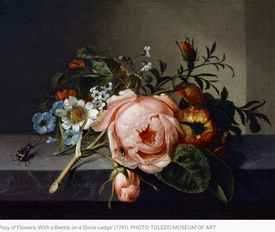 Ruysch continued to paint lush works, the best of her career; more than half of her paintings on display are dated after 1700. As she aged, her paintings became smaller; her last one, the delicate "Posy of Flowers, With a Tulip and a Melon on a Stone Ledge" (1748), hung near the exhibition's end, is just over 6 by 6 inches. It lacks her trademark vitality, but it bestows on viewers the poignancy of a red flower drooping over the edge.