



Washington
Except when they are annoying, insects often go unnoticed. But not by a Dutch artist named Joris Hoefnagel (1542-1600). Hoefnagel observed bugs, along with birds, fish and other creatures, then drew or painted them in intricate detail. To achieve a precise appearance, he embellished some with metallic elements and even captured the irregular cells and veins on the translucent wings of dragonflies by pasting them onto his works.
 In his 30s, Hoefnagel started to paint animals, small and large, in watercolor and gouache on 5½-by-7¼-inch pieces of parchment, commenting in Latin on their beauty, symbolism or connection to God. Nearly 280 of them are gathered into four volumes called "The Four Elements" (c. 1575/1590s), each containing images of animals associated with air, water, earth or fire. The books, once owned by Emperor Rudolf II of Austria, among others, were given to the National Gallery of Art in 1987.
These unique, fragile books star in "Little Beasts: Art, Wonder, and the Natural World." Curated by the museum's Alexandra Libby, Brooks Rich and Stacey Sell, and on view through Nov. 2, the exhibition presents nearly 75 prints, drawings and paintings by Hoefnagel, Jan van Kessel the Elder (1626-1679), and others who conveyed nature's marvels. The curators also borrowed some 60 preserved specimens (from a peacock to an armadillo) from the Smithsonian National Museum of Natural History to juxtapose with the artworks. The result is a thoughtful window on the role artists played in furthering the understanding of nature centuries ago.
 When Hoefnagel came of age, natural history was a nascent science. In Germany, Albrecht Dürer—who inspired Hoefnagel—had created his famous depictions of a hare and a rhinoceros (never having seen one, he worked from a written description and crude sketch). Early 16th-century naturalists Joachim Camerarius the Younger and Conrad Gessner had published treatises—examples on view here. But Hoefnagel preceded by decades such renowned Dutch floral painters as Rachel Ruysch (currently the subject of a traveling retrospective), whose works thrum with beetles, bees and butterflies. As the Getty Museum has written in its collections database, the self-taught Hoefnagel is "a pivotal figure" in Dutch art history as a manuscript illuminator and early still-life painter.
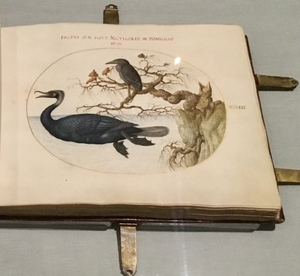
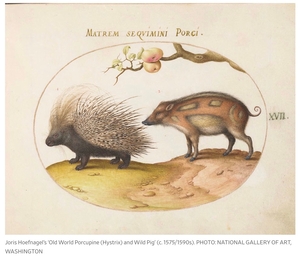 At the center of the first gallery, the "Elements" were at first opened to pages that displayed dragonflies; a porcupine and pig; fish; and a cormorant and heron (they were turned on June 30 to images of beetles; lizards and a frog; a whale, a shark and other fish; and a curlew and crow; they will be changed twice more during the exhibit to show other images). Vitrines and three "Look Closely" monitors dig into Hoefnagel's skills. One compares his stag beetle with Dürer's, noting that Hoefnagel's version is truer in color, texture, pose and shadow, which accurately accentuates the beetle's claws. Hoefnagel also excelled in capturing fur and feather patterns.
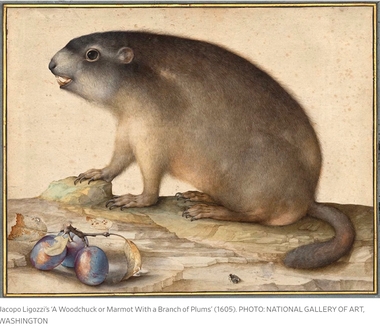
Hoefnagel shares this gallery with contemporaries. Hans Hoffmann's marvelously detailed watercolor and gouache "Red Squirrel" (1578), covering its mouth with its paws to eat, is paired with a taxidermied red squirrel. Jacopo Ligozzi's furry "Woodchuck or Marmot With a Branch of Plums" (1605) is charming, but (according to a wall label) is too "chubby" compared to the adjacent stuffed one.
 As the audience for nature grew, artists began disseminating their images in prints, which fill the second gallery. Hoefnagel's son, Jacob, later a talented painter and miniaturist in his own right, proved to be an excellent engraver. Together, they created "Archetypes and Studies" (1592), which contained 52 prints rooted in "Elements." Their bound volume and separated prints, along with similar engravings by others, fill the room—with variety and a touch of humor added by Teodoro Filippo di Liagno's etchings of animal skeletons (1620-21), from a bat to a tortoise, a goose to a frog, hung salon-style on a central wall.
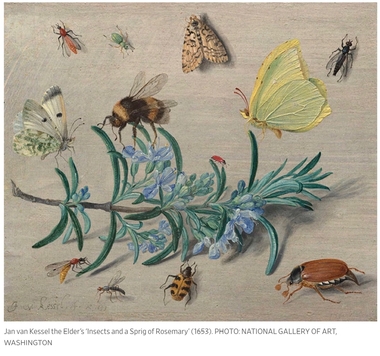
The last gallery is devoted to Van Kessel, a grandson of Jan Brueghel the Elder, who worked nearly a century after Hoefnagel. By then, the Dutch republic had colonized foreign territories, becoming a global trade power and exposing its people to a wider variety of plants and animals. The wealthy amassed specimens, storing them in collectors' cabinets. Van Kessel's fanciful index-card-size arrangements of bugs, painted on copper, were designed to decorate a cabinet's drawers and doors. The cabinets are long gone, apparently, but the individual pieces are irresistible treasures.
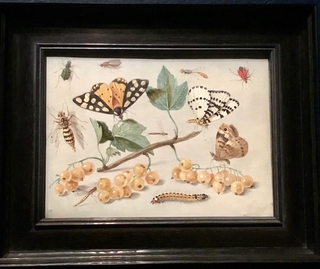 In his compositions, Van Kessel portrays multitudes of moths, butterflies, ants, bees, spiders, grasshoppers and the like, then mixes in flowers, shells or berries, set against a creamy background. He showcases odd species from the Americas, like the Hercules beetle. He playfully poses a lizard roaring; in the same piece, he includes an imaginary locust with dragon features. Sometimes, he ornaments their bug eyes with alluring eyelashes. And in a very playful example, he spells out his name by twisting worms into letters. They're all enchanting.
Here and there in the exhibition, the curators sprinkled in paintings that include but go beyond little beasts: Brueghel's "The Entry of the Animals Into Noah's Ark" (1613), Jan Davidsz de Heem's "Vase of Flowers" (c. 1660), Clara Peeters's "Still Life With Flowers Surrounded by Insects and a Snail" (c. 1610) among them. Though beautiful, they don't steal the show. It's the small works of Hoefnagel, Van Kessel and their peers that appear fresh and engaging.
"Little Beasts" illuminates one chapter of both natural history and art history, and it proves to be a buzz-worthy combination, entertaining as well as educational.
Little Beasts: Art, Wonder, and the Natural World
National Gallery of Art, through Nov. 2