



Denver
Much more than other Impressionists, Camille Pissarro (1830-1903) has a divided reputation. His fans stress his position as the oldest among them, a networker who brought many of them together and prompted Cezanne to paint outdoors, and as the only artist who took part in all eight of the Impressionists' exhibitions, which he helped organize. Some call him "the Father of Impressionism" (a title also given to Manet, Monet and occasionally others), and a 2022 documentary declared, "Without Pissarro, there is no Impressionist movement."
 Pissarro's many skeptics, however, place him in the second rank of Impressionists, an artist whose works are ever-changing (not always for the better), frequently derivative, and sometimes cloying. They may well be the reason that Pissarro has not had a retrospective in the U.S. since 1981—which was also the first in many decades. At the time, the distinguished art critic Hilton Kramer called him a "conundrum," noting that "he has never really emerged as a very distinct—much less a glamorous or popular—figure."
"The Honest Eye: Camille Pissarro's Impressionism" at the Denver Art Museum through Feb. 8, 2026, which was organized with the Museum Barberini in Potsdam, Germany, sides with the advocates. Curated in Denver by Clarisse Fava-Piz, formerly the museum's associate curator of European and American Art before 1900 and now curator of modern art at the Phillips Collection, it displays 95 artworks drawn from his five-decade career. Labeling him "the first Impressionist," it presents Pissarro as a painter who led the way, albeit one focused on unglamorous aspects of everyday life, mostly in the countryside outside Paris. Not for him were the depictions of the lives and leisure of the wealthy or the bourgeoisie favored by Renoir, Cassatt and Morisot.
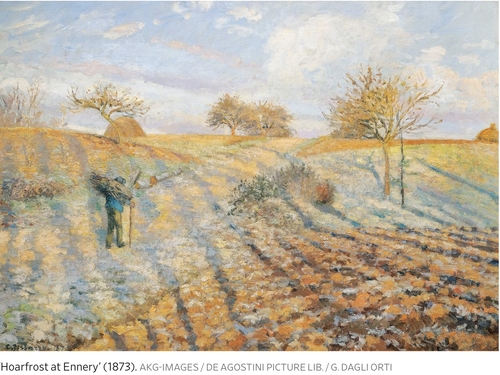
Organized both chronologically and thematically, the exhibit begins smartly with an unquestionable Pissarro masterpiece: In loose brushstrokes and soft shades of yellow, blue and tan, "Hoarfrost at Ennery" (1873) portrays a peasant traversing a wintry landscape with a load of sticks on his back. The morning frost glistens, and—in a clever device—the low sun glimmers through a row of unseen, leafless trees behind the artist, casting crisscrossing, rhythmic shadows on the furrows.
The display then reverts to Pissarro's beginnings. Born in St. Thomas in what was then the Danish West Indies, Pissarro was sent to school in the Paris suburbs at age 12, but declined upon his return five years later to take up his father's profession as a merchant. Instead, he sketched and painted throughout the Virgin Islands and in Venezuela, at times with a Danish artist named Fritz Melbye. Early works, such as "A Creek in St. Thomas (Virgin Islands)" from 1856, share a kinship with Danish golden age painting.
After moving to Paris in 1855, Pissarro took a few private art lessons, then enrolled in an independent drawing school, where he met Monet, among others. He successfully submitted his first painting to the Paris Salon in 1859, a prosaic little picture of a donkey (not in the show), and was off—trading ideas and techniques with other painters and moving slowly toward the looser brushstrokes, natural light, brighter colors and spontaneity of Impressionism. By 1870 or so, he seemed committed, as evidenced by the shimmering water in "The Lock at Pontoise" (1872); the wet, shiny cobblestones and mist of "Route de Versailles, Louveciennes, Rain Effect" (1870); and the muddy ground and haziness of "The Thaw or The House of Monsieur Musy, Louveciennes" (1872).
But Pissarro hadn't really settled on his style. In sections headed "Portrait of a Family," "The Impressionist Journey," "Rural Communities" and so on, Pissarro seems to be yearning for one, as he experiments and borrows from fellow painters ranging from Fantin-Latour, with his meticulous details, to Seurat, with his pointillism.
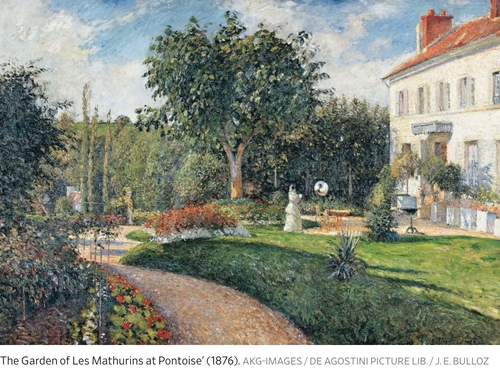 Pissarro soon gave up on pointillism, noting its conflict with the richness and spontaneity of Impressionism. But it no doubt affected the style of his most distinctive paintings, the ones that are recognizably his. They are generally pleasant if bland landscapes, rendered in small, precise daubs of thick paint, and they begin to appear by the mid-1870s. These works, such as "The Garden of Les Mathurins at Pontoise" (1876) and "Orchard at Pontoise, Sunset" (1878), are visually appealing but seem a bit precious.
He wasn't committed, though, as two winter paintings illustrate. He deploys his small marks in "Snow Scene at Éragny (View of Bazincourt)" from 1884, and is back to sketchier, impressionistic brushstrokes in "View of Bazincourt, Snow Effect" from 1892. "Plum Trees in Blossom, Éragny" (1894), his picture of a woman walking on a path amid flowering trees, combines the two: crisp little strokes for the blossoms, and larger, free ones for the path. It's a charming, light-filled image.
This inconsistency doesn't diminish the portion of Pissarro's paintings that is luminous. But it does contribute to Kramer's quandary. "The Honest Eye" tries to address that by asserting that Pissarro painted exactly what he saw. That's fair. But as he was never at the forefront of Impressionism stylistically, it is problematic to cast him as its father. He was a mentor to many and an important organizer, but in the end one comes away feeling that those talents surpass his achievements as an artist.