



Portraits come in many incarnations—the rigorous realism of Holbein, the rococo elegance of Gainsborough, the harsh frankness of Lucian Freud, to name just a few. Going beyond resemblance, many incorporate symbols alluding to character traits or occupation or circumstances.
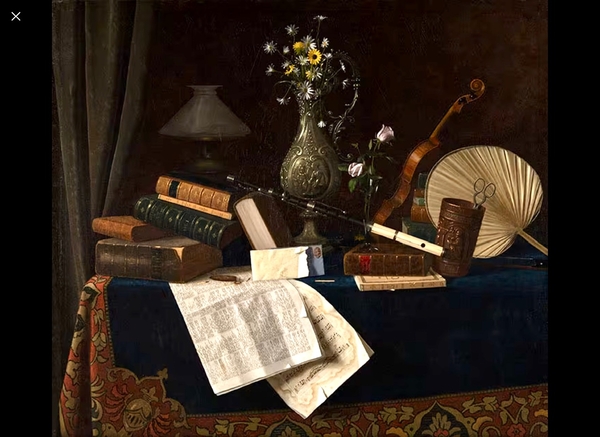
In 19th-century America, William Michael Harnett (1848-1892)—the leading illusionist, or trompe-l'oeil, painter of his era, celebrated for his polished, minutely detailed still lifes—doubled down on the use of symbols in portraits. In his glorious painting "Ease" (1887), at the Amon Carter Museum of American Art in Fort Worth, Texas, he captured the essence of his patron by painting the treasured belongings, surroundings and trappings of his life, but not the man himself.
Too poor to hire models, Harnett focused on still lifes, mindful in particular of 17th-century Dutch art as precedent. But he moved away from fruits, flowers and other signifiers of abundance and toward portrayals of possessions. He meticulously painted beer mugs, pipes, matches, newspapers and other everyday objects, paying scrupulous attention to texture. So deceptively real are his works that in 1886 he was briefly arrested as a counterfeiter for his paintings of currency, and when "The Old Violin" was shown that year at the Cincinnati Industrial Exposition a policeman was stationed beside it to prevent visitors from touching it to see if it was real.
Harnett found an enthusiastic clientele among merchants and industrialists who appreciated his male themes and appealing arrangements; they proudly hung his works in offices, stores and saloons. One such fan was a Massachusetts envelope manufacturer named James T. Abbe, who commissioned "Ease" for a reported $5,000 (about $170,000 today). He instructed Harnett to select from among Abbe's own possessions for the still life, and Harnett chose objects that reveal the comfortable, cultured aspects of his client's life. Spread out on a table, which is covered with a velvet cloth, the evidence includes several frayed books, including "The Iliad"; a violin and a flute; a palm-leaf fan; daisies in a metal ewer; and more. These items, all life-size, reflect the taste of a Gilded Age industrialist.
Harnett adopted the traditional pyramidal structure of Dutch tabletop paintings for "Ease," at 48 by 60 inches one of his largest and most ambitious works. The triangular arrangement, mirrored by the shape of the papers hanging from the table's edge, is intended to suggest stability and to help guide the viewer's eye through the painting—as does the theatrical lighting, which accentuates the newspaper, the musical score and the envelopes, each with palpable wear-and-tear details.
Both the white crinkled envelope (which Harnett situated near the crux of the subtle X structure overlaying the work to add drama to the painting) and the newspaper refer to Abbe's professional life as a manufacturer and as president of the company that published the Springfield Daily Union. Another dimension of Abbe, scholars say, is encoded in a light-brown leather account book. It belonged to his business partner, and is said to contain records of the children of a slave the partner's grandfather had once owned. Abbe, a committed Republican, probably had endorsed the Emancipation Proclamation.
At first glance, Abbe's pile looks a bit precarious; in real life, would those books remain in place? And why is the cigar still smoldering, burning a little hole in the newspaper? Harnett had much simpler taste than his patrons, and while "Ease" is not a vanitas painting auguring death, he was known for incorporating traces of humor and irony in his paintings.
Oddly, that cigar turned out to be an unwitting premonition. Abbe hung "Ease" in a room off his office at the Holyoke Envelope Co. factory, and in January 1888 the plant was destroyed by fire. "Ease" survived, but Abbe soon sold the work to railroad baron Collis Potter Huntington to help relieve his financial difficulties.
Harnett, suffering from several health issues, died about five years later, at age 44. He never saw his reputation soar, which began in the late 1930s. He never knew that "Ease" turned out to be a precursor of modernist artworks like Marsden Hartley's "Portrait of a German Officer" (1914), which also stretched the boundaries of portraiture. And he never knew that, unlike the verdict of an early viewer who dismissed his paintings as "mere legerdemain," today they are seen as magical in a positive sense.