



Boston
How lucky is the Museum of Fine Arts, Boston. It owns the largest collection of watercolors by Winslow Homer (1836-1910) in the world. And as Homer famously said, "You will see, in the future, I will live by my watercolors."
Visitors to the MFA through Jan. 19, 2026, are also lucky: They can view nearly 50 of these treasures, dated from 1847 to 1904, along with some oils, prints, borrowed watercolors, and other materials, in "Of Light and Air: Winslow Homer in Watercolor." Vulnerable to damage from light, humidity and other dangers, MFA's watercolors have not been on view together for almost a half century; some have not been seen at all in decades. "Of Light and Air" is a not-to-be-missed occasion.
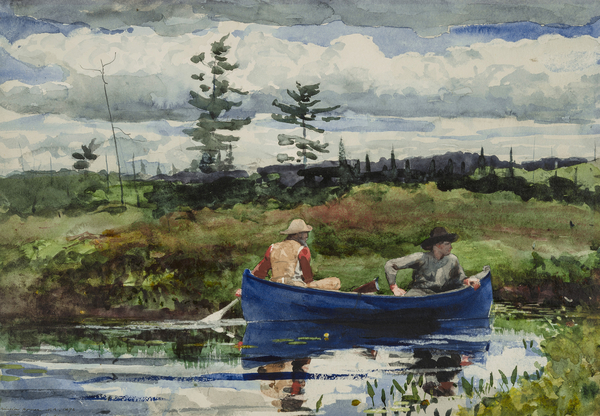 The Blue Boat |
It opens with "The Blue Boat" (1892), a stunning work. With its blue sky; puffy clouds, whitened at the top by sunlight; trees and grasses limned in spare, confident strokes; a central hunter clothed in contrasting autumnal colors, and subtle reflections in the blue water, it's sheer perfection—a prime example of why Homer is arguably America's greatest watercolorist. By using bold but looser brush strokes, striving to capture fleeting moments and atmosphere, and tackling ambitious subjects in what had been considered a secondary medium, Homer changed the practice and prestige of watercolor in America.
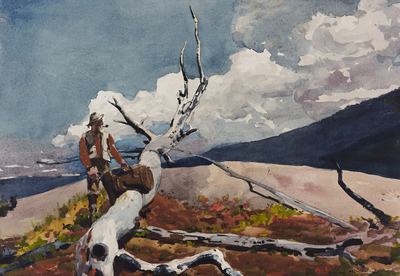 Woodman and Fallen Tree |
Homer started as just a boy. Encouraged by his mother, Henrietta (an accomplished watercolorist who is represented here by three nature studies), he created works like "Farm Scene" (1847). It's competent, but muddy, evidence that Homer did not yet understand how to use watercolors.
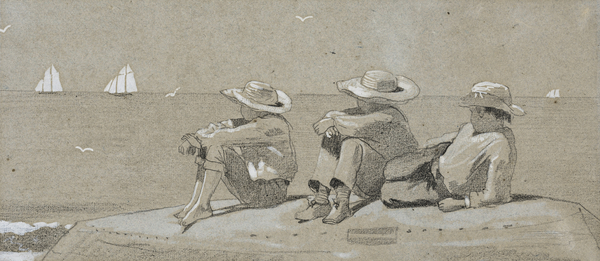 Three Boys on a Beached Dory |
His next years were filled with illustration. At age 17, Homer was apprenticed to a Boston lithographer, where he practiced his draftsmanship and learned about composition, process and business. Then he worked as a freelance illustrator, contributing drawings to popular magazines, especially Harper's Weekly, which sent him to the front lines of the Civil War. His ink-wash eyewitness accounts were widely printed and engraved, and might be termed his first watercolors as an adult.
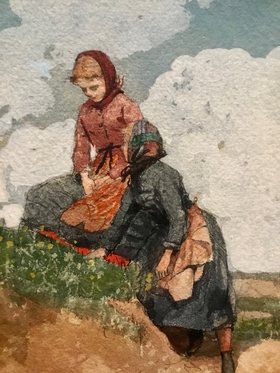 Detail-Girls on a Cliff |
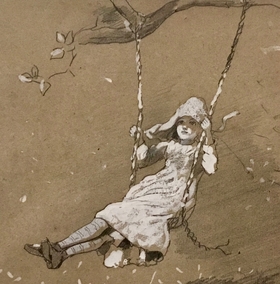 Detail-Girl on a Swing |
But in the summer of 1873, which he spent in Gloucester, Mass., Homer had created his first series of watercolors, the seed of his virtuosity. MFA's example from that summer, "Three Boys on a Beached Dory," is a charming grisaille work depicting the children, wearing broad-brimmed hats, looking at sailboats on the horizon. In "Boy in a Boatyard" (1873), a borrowed work of a barefoot child lost in thought, Homer sometimes layers paints, but also takes advantage of watercolor qualities. Critics perked up, praising Homer's "individual way of looking," according to a wall label.
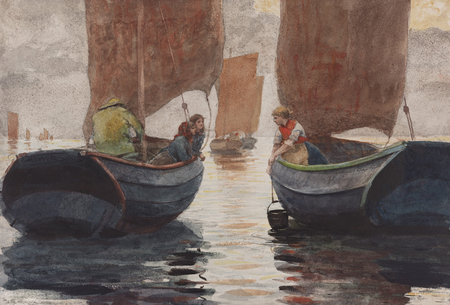 An Afterglow |
He painted these images quickly, aiming to capture a moment (later tinkering if needed). The surge in "Breaking Wave (Prouts Neck)," from 1887—the last in the show—would be gone an instant later. Poignantly, it is juxtaposed with "Driftwood" (1909), Homer's final oil painting. Despite his own verdict, both mediums would bring him lasting, well-deserved, renown.
Washington
Is it any wonder then that the poster image for "American Landscapes in Watercolor From the Corcoran Collection," at the National Gallery of Art through Feb. 1, 2026, is by Winslow Homer? His "Hudson River, Logging" (1891-92) is nearly as stellar as "The Blue Boat." Homer's bravado strokes of bold colors, with highlights in white, create a sparkling vision of two men in the great outdoors.
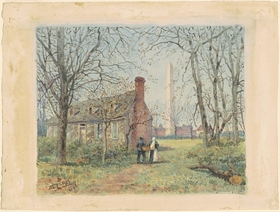 Walter Paris's "David Burns's Cottage and the Washington Monument" |
The earliest examples are more interesting historically than aesthetically. "Falls of the Potomac" (1800-10) by William Russell Birch and "Harpers Ferry From Below" (1825-27) by Thomas Doughty provide looks at the countryside in its early days. "View of the North River From the North West Corner of Fort Clinton—West Point" (1837) and "Constitution Island and Foundry from West Point, New York" (c. 1837) are the work of Seth Eastman, an artist-soldier who taught drawing to West Point cadets learning cartography. Walter Paris's "David Burns's Cottage and the Washington Monument" (1892) illustrates the obstinacy of the farmer who owned the land now occupied by the White House; he sold it—eventually—after George Washington himself negotiated, but he and his family kept the cottage for decades.
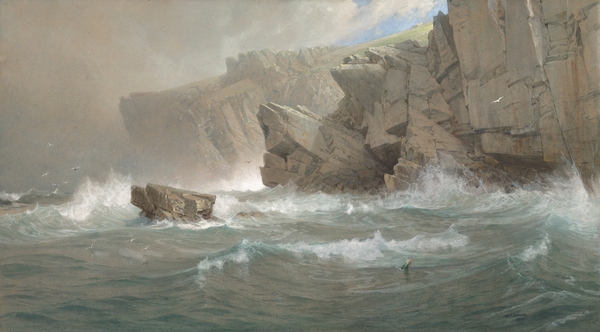 South-West Point, Conanicut |
The most distinctive artwork in the show is the largest, almost 5 feet across. Looking up, William Trost Richards painted the cold, rocky waters in "South-West Point, Conanicut" (1878/1879) before a massive cliff made of arrowhead-sharp rocks. Near the top of this bleak scene, there's a peek at the lifting mist and emerging blue sky. Richards intended his piece, painted on rough paper, to look like an oil, and it does.
"American Landscapes" offers much more: a John Marin marine abstraction, "Flint Isle, Maine—No. 1" (1947) hung near George Henry Smillie's realistic "Seal Harbor, Mount Desert" (c. 1893); Alma Thomas's verdant "Winter Shadows" (c. 1960); frolicking deer in "Landscape With Deer, North Carolina" (c. 1820) by Joshua Shaw; and three fluid works, dated 1988 and 1991, by Donald Holden, who painted wet-on-wet from memory.
While just a sampling, the show whets one's appetite. It suggests the need for a dedicated space for rotating displays of the Corcoran's paper treasures.