



New York
The art of German painter Gabriele Münter (1877-1962) has a strong visceral appeal. Her vibrant colors and simplified forms act like gravity, pulling in viewers. Her choice of homey subjects, unusual angles, or surprising vantage points adds to the tug, and her use of black outlines, for emphasis, helps sustain it. Münter's world seems enchanting—although, outside of the Milwaukee Art Museum, which owns the only large public collection of her work in the U.S., it's not easy for Americans to gain entry.
 "Head of a Young Girl" |
In the early years of the 20th century, Münter stood at the vanguard of European modernism. She painted alongside other pathbreaking artists, and co-founded both Der Blaue Reiter (The Blue Rider) school of artists in Munich and its predecessor cooperative, which fostered the flourishing of new German art. Yet Münter has long been overshadowed by contemporaries like Ernst Ludwig Kirchner, who veered into acerbic expressionism, and Wassily Kandinsky, who migrated toward pure abstraction.
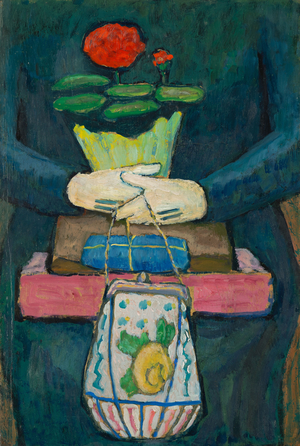 "Still Life on the Tram" |
Münter started down this path while visiting relatives in the U.S. from 1898 to 1900. With a Kodak camera, as a side gallery of her photos shows, she experimented with lighting effects and compositional strategies—cropping, framing, unusual angles.
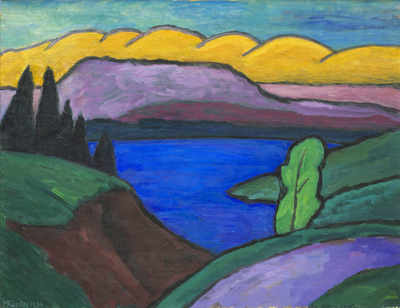 "The Blue Lake" |
Murnau, a village in the Bavarian Alps about 45 miles from Munich, became Münter's wellspring. Smitten by its landscape, its light and its colorful dwellings, she bought a cottage there, which was both a place of solace and, initially, a gathering point for sharing ideas and painting with Kandinsky, Alexei Jawlensky and Marianne Werefkin.
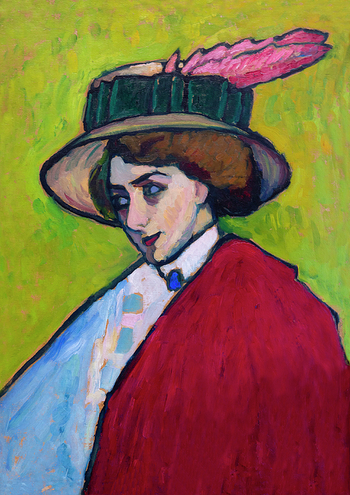 "Portrait" ...Polish Woman |
Münter said that portraits were the most difficult genre for her, largely because she wanted to go beyond physical appearances, but the examples here show she succeeded. Staring directly at the viewer, her "Self-Portrait in Front of an Easel" (c. 1908-09) portrays her as perplexed, perhaps over that very challenge. "Portrait of a Young Woman in a Large Hat (Polish Woman)" (1909) involves a gorgeous red coat, matching lips and a plumed hat set against an acid green background, but attention goes straight to the woman's angled face and expressive eyes, perhaps approving, perhaps flirtatious, definitely evincing personality.
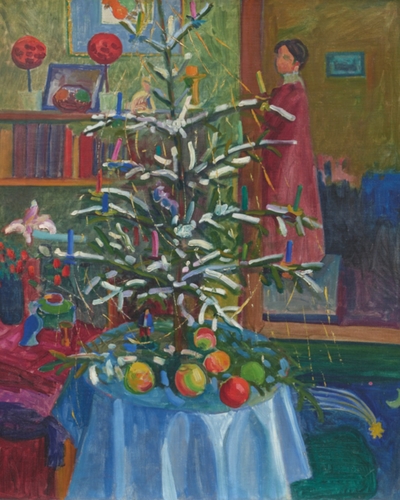 "Christmas Still Life" |
"Contours of a World" shows Münter as master of a delightful style, in each genre, that is more complicated than it looks—honest but always inventive.
The Guggenheim is the perfect venue for a Münter exhibition because its collection includes works by many other artists in Germany, Austria-Hungary and Russia who were devising their own brands of modernism at the same time. And the museum has mounted an exhibition called "Modern European Currents," on view through Jan. 11, 2027, that provides a look at this artistic environment.
The display, of nearly 30 artworks (including watercolors that rotate) chosen by Ms. Fontanella with fellow curator Vivien Greene, dwells on the years between 1910 and 1918, when many painters had similar ideas at first, and then diverged radically.
That is most easily seen with Kandinsky, starting with four landscapes he painted in Murnau. His colors are as intense as Münter's, but his forms are freer, less blocky. His later work, "Painting With White Border" (May 1913), contains recognizable signs of his native Moscow (where he'd recently visited), but is far more abstract and an example of his theory that colors manifest sound and feelings.
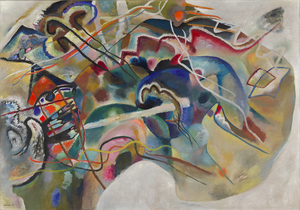 Kandinsky's "Painting With White Border" |
Paintings by Natalia Goncharova, Liubov Popova, Kazimir Malevich, Egon Schiele and others provide a look at different, usually more radical, deviations into modernism. They demonstrate why this initiative to show more works from the permanent collection—especially when complementary to a special show—is an excellent one. "Collection in Focus," as it is called, was started by Mariet Westermann, who took the museum's director post in 2024 and designated a gallery, always, for rotating exhibits of the museum's permanent holdings. This iteration is an enlightening companion to "Gabriele Münter: Contours of a World."