



Detroit
Encyclopedic museums can feel very similar. By endeavoring to tell the entire history of art, as far as their collections allow, they sometimes underplay a concentration within their holdings that makes them distinctive.
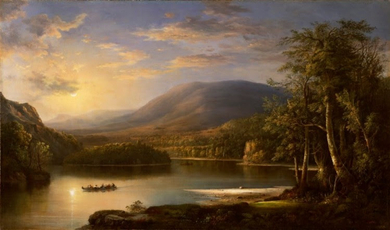 Duncanson's "Ellen's Isle, Loch Katrine" |
Ms. Mercer decided to display African-American art history in 50 objects, spanning the years from 1846 to 1986, drawn from the Center's 700 works. She chose a straightforward chronological hang that presents many wondrous works and several revelations.
Three other artists, now well-known, enliven these early years. In "Peasants in Forest" (1879-80), Edward Mitchell Bannister painted a lush, invented Barbizon-style landscape; in 1876, he was the first black artist to win a national award, but was then denied the honor because of his race until white artists protested. A generation later, Henry Ossawa Tanner attended art schools in Philadelphia, where he studied with Thomas Eakins, and Paris, where he won international recognition. "Flight Into Egypt" (1899) perfectly captures his predilection for mystical biblical scenes rendered in broad, loose brushstrokes. Mary Edmonia Lewis, a mixed-race sculptor who attended Oberlin College, learned her trade in Boston, then moved to Rome. Here her classical marble sculptures, "Hiawatha" and "Minnehaha," from 1868, honor her Ojibwe roots.
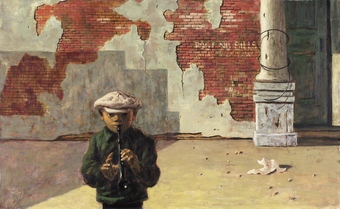 Lee-Smith's "The Piper" |
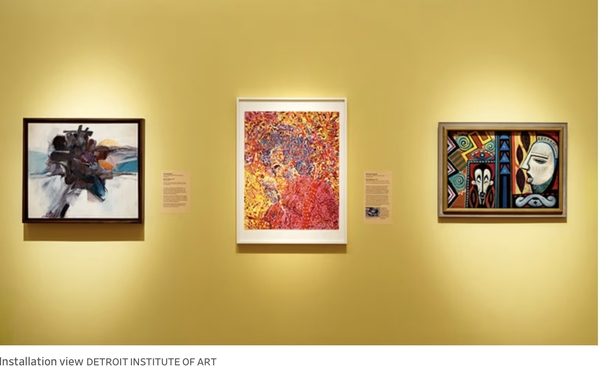
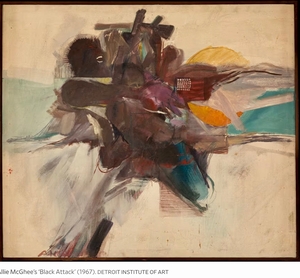
These galleries hold surprises, too. In "Single Track" (1946-50) by Vertis Hayes, a little-known social realist, a railroad track dominates the center, while on the right a dirt road, shacks and an industrial tower provide a view of black life. The left side, with a paved road, big cars, two-story buildings and white shoppers, shows the contrast. What might be a cliché is animated by Hayes's confident brushstrokes and vibrant colors. Hughie Lee-Smith sounds a similar note in an urban setting, with his poignant "The Piper" (1953)—a small boy and his music, alone in a blighted neighborhood. And Allie McGhee's semi-abstract "Black Attack" (1967) takes up the subject of that year's riots in Detroit: Amid violent brown slashes, a black face and arm are visible, resisting, holding an American flag.
In the final gallery, African-American art realigns with mainstream trends toward abstraction and color fields. Among the standouts are Alvin Loving's "Untitled" (1967), a mix of brightly hued advancing and receding blocks within an intense red box; Felrath Hines's "Untitled" (1979), with floating orange forms; and Hale Woodruff's exuberant "Carnival" (c. 1958). Woodruff, whose works in previous galleries include the figurative "The Art of the Negro: Artists (Study)" (c. 1950-51) and the powerful "Ancestral Memory" (mid-20th century), shines as a talent to know.
 Strictly speaking, these galleries—limited by gaps in the DIA's holdings and by space—provide only an abbreviated history of black art. Ms. Mercer said she ended with the '80s because by then the definition of art had expanded to include more diverse styles, issues, voices—and because more African-American artists began to be shown alongside artists of different races and ethnicities. As a result, works by artists like Romare Bearden and Jacob Lawrence, who had already attracted attention from the art-world establishment, are missing from these galleries, saved for the museum's contemporary art galleries, which are being renovated. It's an idiosyncratic decision, no doubt also affected by the galleries' footprint, but a regretful one.
Still, truncated as this history may be, these galleries highlight a strength other museums lack—and are racing to catch up with. And they give visitors one more reason to visit the many riches of the DIA.