



Mount Vernon, Va.
Always an assiduous public-image crafter, George Washington paid meticulous attention to both his personal appearance and that of his beloved Mount Vernon estate, where he constantly received friends, associates and admirers. He raised the roof of the house he inherited; added wings, a porch and a cupola; and selected—along with his wife, Martha—the interior's paint colors, wallpapers and furniture.
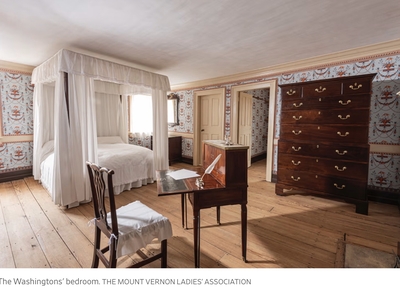 Were he alive today, the father of our country—who was also a forgiving man, cognizant of his own potential errors—might well be pleased with recent activities at his plantation on the Potomac. The Mount Vernon Ladies' Association, which in 1860 took possession of a dilapidated home nearly devoid of its contents, has been trying ever since to restore it to its appearance in 1799, when Washington died. But, dealing with incomplete or no information, mistakes were made. This year, the nation's 250th anniversary, Mount Vernon is edging toward completion of a multiyear, $50 million project—aided by new technologies, new research and newly resurfaced documents—that is reversing inaccuracies in the bedroom where he really slept, the study where he and Rochambeau likely plotted their strategy for Yorktown, and the rest of the mansion.
Some critical changes are imperceptible. Because age, termites and water had attacked wooden beams, the house sat unattached on its foundation; it has been reaffixed, and moisture levels controlled. Deteriorated framing elements have been restored to their 18th-century state or replaced. A modern, but hidden, truss system is shoring up the study's floorboards, made necessary not only by the weight of thousands of visitors, but also by the inaugural opening next October of the 18th-century cellar below.
But if you have not been here in, say, a dozen years (I last visited in 2013), you'll see an almost completely different abode. The walls of the master bed chamber, for example—previously cream-colored—are now decked in an orange arabesque wallpaper with swags, birds and bouquets on a light-blue background. It's a re-creation of a circa 1794 wallpaper, chosen by curators based on analysis of fragments recovered from the room—a reflection of the current restorationist philosophy to make educated guesses, rather than default to safe, nondescript colors. The Washingtons, records show, added wallpaper throughout the house in 1797—and its reappearance enlivens a house that had looked dull.
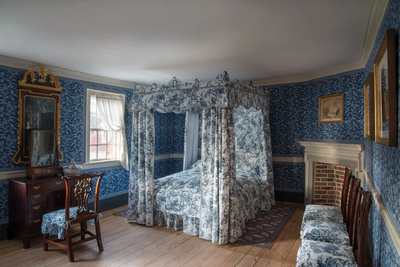 The Blue Room |
On the first floor, the front parlor, with its wooden wainscoting and classical door frames, is more elegant after conservation restored small details in the decorative moldings. The discovery and acquisition in 2013 of the Fairfax Account Book, an inventory of furnishings once owned by Washington's neighbors and including many later bought by or given to the Washingtons, enabled curators to find more comparable replicas of the lost, original chairs and tables. And deeper analysis of paint layers led to a big switch: The original wall color was not the bright blue of restorations past. It was, and is now, a light stone color. The room looks more refined than it was previously
A subtle color change also restored the appearance of the neoclassical "New Room," which Washington added in the 1770s and '80s as a grand space for entertaining, displaying art, making a statement. In the 1930s, it was cream-colored; later it was painted green. But it wasn't the right green: The upper walls now wear the correct copper-based "verditer" green paint, with the tone of malachite, complemented below the chair rails in a buff color. The dark green in the decorative friezes, as well as the lintels and pilasters of the Palladian window, is newly accurate, too. The ceiling cove, once green, has been returned to its original white color. And more furnishings—original or replicas—have been placed in the room (in recent years, Mount Vernon has purchased more than 1,000 items, large and small, owned by the Washingtons).
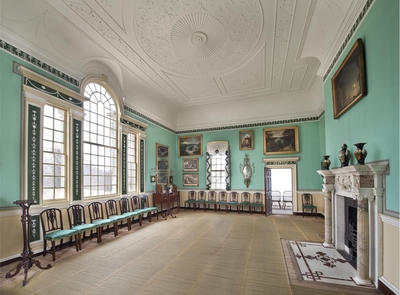 The New Room |
These new alterations complement changes made on the second floor that date to about 2017. There, for example, the Blue Room has regained its 18th-century mantel (which had been placed in storage) and period-style furniture; it now has a spectacular wallpaper whose pattern of white flowers, birds and insects is set on a deep blue ground, a custom-made re-creation of a 1790s pattern found in the French royal wallpaper collection. The bed, fitted with exquisite blue-and-white toile hangings, reflects the Washingtons' taste.
Across the landing, the Yellow Room also boasts expensive furnishings, especially the bed, which is covered in bright yellow damask, re-creating a bed Washington acquired in 1758. The walls—at one point painted yellow with light-blue trim, at another a paler yellow with white trim, and once enveloped in a patterned green wallpaper—are now covered in an appropriate light-yellow, white and gray wallpaper, the best guess at what was there.
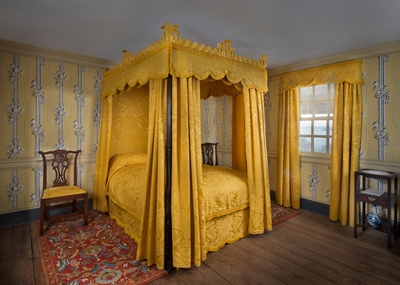 The Yellow Room |
Mount Vernon is bigger than the house—it has slave quarters, outbuildings, gardens, the Washingtons' tomb, a museum and an education center, with a revised permanent exhibition focused on Washington's life and virtues, opening in part this coming March and fully installed with additional materials in June. But the mansion—increasingly closer to his own elegant vision—most embodies the persona Washington strived to project: as a gentleman, as a sophisticate and, subtly, as a national leader who valued home life and always longed to return to it.