



The Passion of Jesus ranks among the most common themes in Western art, painted or sculpted by artists too numerous to count, with many striving to create artworks both emotionally stirring and original. In the small Capponi chapel just inside the church of Santa Felicità in Florence, Jacopo Carucci—better known as Pontormo—devised an altarpiece that is among the most imaginative, most stunning visions of a harrowing episode in Christ's final days on earth.
"The Deposition From the Cross" (1525-28)—a theatrical swirl of exaggerated bodies, rendered in bold, unusual colors and in (sometimes) unnatural, unstable poses—is widely acknowledged as a radical break from the harmonious, naturalist principles of the High Renaissance to the more dramatic, expressive, emergent style of Mannerism. For Pontormo, who studied with Leonardo da Vinci and was influenced by Michelangelo and Dürer, it's the painting that shows him stylistically emancipated from those giants.
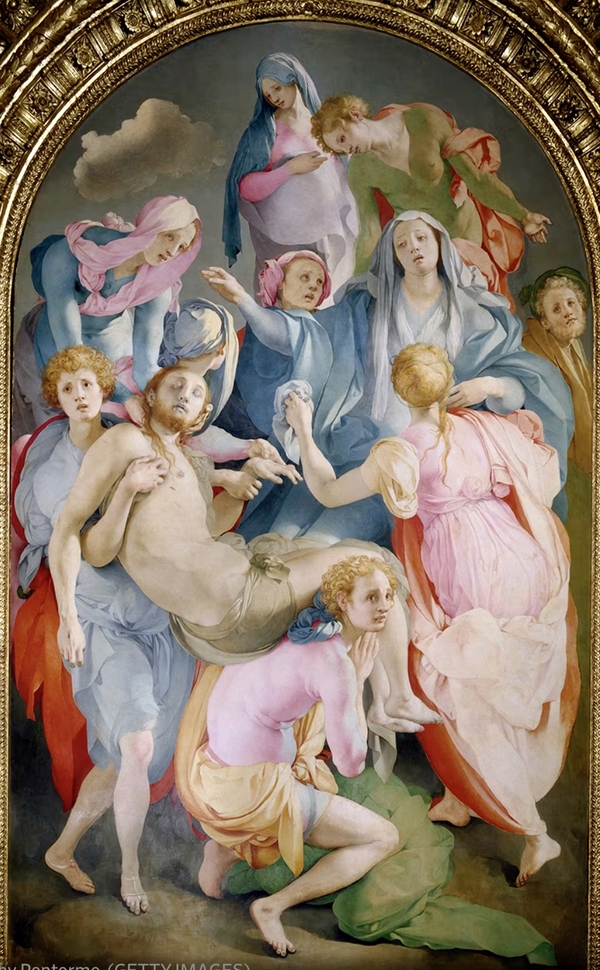
But if Pontormo's chosen scene is unclear, his unorthodox artistic decisions are not. As if to emphasize the tumult—Matthew's Gospel said the world had gone dark, the ground had shaken and rocks had split open while Christ was on the cross—Pontormo rejected the stable pyramidal structure of Renaissance paintings in favor of a freer, highly charged circular composition. Into it, he compressed 11 entangled, elongated figures, who seem to float in space. Neither Christ nor Mary occupies the center, the natural place for the eye to rest; instead, there is only the arm of a woman holding a cloth (to what end is a minor mystery).
Mary, her right arm extended toward Christ in a gesture of farewell or a reference to heaven above, forms part of a diagonal cutting across the painting that adds more dynamism to the drama. Tension is also evident in the angels' poses: At left, one seems to bear most of Christ's heavy weight, while the other, holding Jesus from below, carries Christ while crouching on his toes, which barely touch the ground—a nearly impossible feat. Other bodies in the painting—the woman holding Jesus' head and the one dressed in green, supporting Mary—seem to be weightless, suspended in mid-air. The man in a green hat, on the far right, is thought to be a self-portrait of Pontormo, yet the traditional male witnesses to the deposition, Nicodemus and Joseph of Arimathea, are nowhere to be seen.
Those distracting acidic greens are only one unusual choice in Pontormo's palette. His elegant pinks, mauves, light blues and reds are rare in such solemn scenes; almost otherworldly, they beautifully draw attention to all the gently curved bodies. The whole painting is illuminated by light from the right, which—in the Capponi chapel—is amplified by natural rays that filter through a stained-glass window on the wall.
Pontormo wasn't painting in a vacuum, and his decision to shake up artistic conventions may also reflect the turbulent politics, local and liturgical, of his times. Florence, wracked by dissent and besieged by the Holy Roman Empire, remained in ferment until the Medicis consolidated power in 1530 into what became the Duchy of Florence. The disarray may have encouraged his decision to make a complex, unsettling painting.
Meanwhile, in Germany, Martin Luther had questioned the Catholic doctrine of transubstantiation, the literal transformation of bread and wine into the body and blood of Christ. Pontormo, said to be deeply religious, may be countering Luther, expressing his belief in the Eucharistic mystery by unconventionally adding angels to the scene. They seem to be lowering Christ's corpse, which is thrust forward from the picture plane, onto the altar below the painting. Their presence may allude to the hymn "Panis Angelicus," or "bread of angels," written by St. Thomas Aquinas in the 13th century as a poetic reference to the presence of Christ in the consecrated host.
In the end, this peculiar, powerful painting remains an enigma, an intentionally ambiguous work that is nevertheless a milestone in the development of Early Mannerism and a compelling reason to visit Santa Felicità when in Florence.