Houston
More Frida Kahlo? The Mexican artist (1907-1954), who died a relative unknown, has been given at least a dozen museum exhibitions in the past decade. Her artworks, exotic looks and troubled biography have inspired legions of artists. Her image, with its trademark unibrow, graces hundreds of commercial products, and she has been celebrated in movies, plays and even a 2022 opera about her and her husband, Diego Rivera, that will take the stage of the Metropolitan Opera in May (accompanied by a related show now open at the Museum of Modern Art). Her star eclipsed Rivera's years ago. For museums, she's box-office magic, ranking with Van Gogh, Picasso, Monet and Warhol.
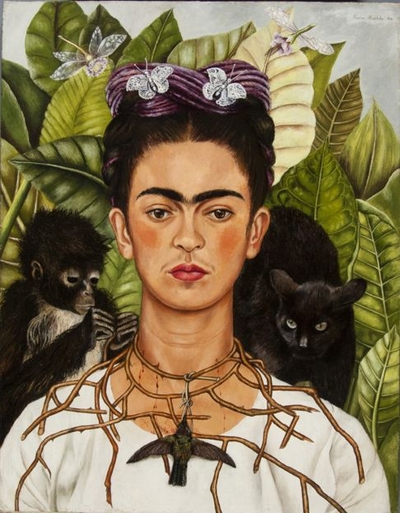 Self-Portrait with Thorn Necklace and Hummingbird |
But instead of simply riding or feeding the frenzy, the Museum of Fine Arts, Houston, stakes out enlightening new ground in "Frida: The Making of an Icon," on view through May 17. In a massive display featuring 35 of her paintings; nearly 200 related artworks or objects; and more than 200 toys, sneakers and other knick-knacks, curator Mari Carmen Ramírez and her team provide the intellectual underpinnings for the "Frida" phenomenon. They dissect her appeal to the many groups—from Surrealists and feminists to the LGBTQ+ community and the disabled—who since the 1930s have embraced her as one of their own.
Wisely, the entry gallery takes on doubters of Kahlo's gifts with a display of several accomplished early paintings. At age 19, she created the subtly sensual "Self-Portrait (In a Velvet Dress)" (1926). She'd begun painting only months earlier, after being injured in a traffic accident that maimed her for life. She was soon producing works, like the striking "Portrait of Alicia Galant" (1927), that acknowledge European masters—particularly Mannerists like Bronzino (notice Galant's elongated hands and emotionless face), and also Futurists, Symbolists and others.
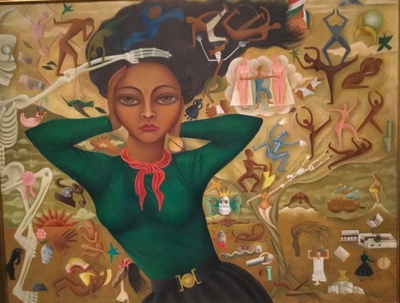 Rosa Rolanda: Self-Portrait |
Before long, she developed her own style, dense with symbols, drawing on what Ms. Ramírez calls her many "selfs." Kahlo was mixed-race; disabled by polio and plagued by chronic pain from the accident; a Communist and activist; a transgressive bisexual; a wife devoted to a cheating husband whose career, in life, overshadowed hers by far. Kahlo was her best subject, not only alone in her self-portraits, but also, in "Diego and I" (1949), with Rivera revealingly occupying her forehead and headspace. He portrayed her as well, as in the closely cropped "Portrait of Frida Kahlo" (c. 1935), which emphasizes her indigeneity. Others did, too, like Roberto Montenegro with "Portrait of Frida Kahlo" (1937) in folkloric dress, and such photographers as Imogen Cunningham, Julien Levy and, most of all, Nickolas Muray, whose images, like "Frida With Olmeca Figurine, Coyoacán" (1939), have circulated widely.
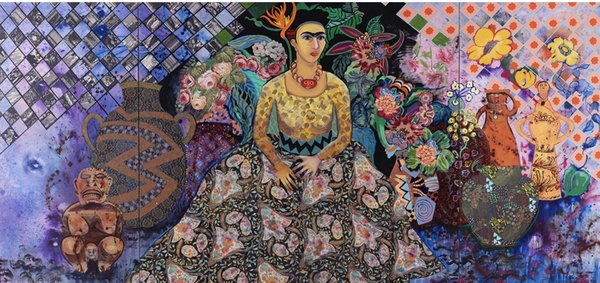 Miriam Shapiro's "Conservatory (Portrait of Frida Kahlo)" |
From there, section by section, the exhibition groups her artworks with those who claimed or emulated her. "Surrealist Affinities" shows her interest in death, dreams and the unconscious, the concerns of those artists. Kahlo denied the connection, but some of her works fit the description, most famously "The Suicide of Dorothy Hale" (1938-39), which horrifyingly depicts the socialite and actress tumbling from a tall building and landing in a pool of blood. Kahlo spills her own blood in "The Heart" (1937), one of many works that address her emotional distress from her turbulent marriage and damaged body. Her near-contemporary Rosa Rolanda expressed similar turmoil in her intriguing "Self-Portrait" (1952)—a maze of sun, clouds, skeletons and other symbols that she, covering her ears and dressed in brilliant green, weathers.
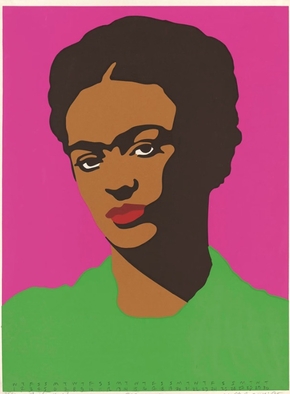 Garcia's silkscreen portrait of Frida |
In the 1970s, Chicano artists in the U.S. adopted Kahlo as an emblem of their cultural pride and demand for equal rights. The exhibition reassembles part of a 1978 group show in San Francisco of tributes to her. A silkscreen Frida portrait (1975), but with deeper brown skin, by Rupert Garcia, is thought to be the first Chicano appropriation of her image. "Altar for Frida Kahlo" (1978-87), a Day-of-the-Dead-style installation by Carmen Lomas Garza, refers both to Kahlo's appearance and to her traumatic miscarriages, a result of the accident. This reverence for Kahlo continued with "Neo-Mexicanisms," when artists of the '80s and '90s, including LGBTQ+ and anti-globalism protesters, deployed Mexican imagery and Kahlo-style portraits in their art.
The most difficult section, "Gendered Dialogues," delves into Kahlo's sometimes androgynous appearance and, more poignantly, her boundary-breaking works about her body and the pains of childbirth and miscarriage. "The Broken Column" (1944) famously opens her chest to show her injured spine, her body wounded by a tight corset and nails, set in a barren landscape that alludes to her inability to bear children. Artists from Kiki Smith, with "Untitled (Paper Body with Fetus)" (1989), to Judy Chicago, with "Birth Tear Embroidery 3" (1984), picked up the theme, often graphically.
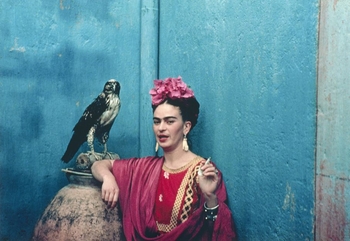 Murray's "Frida with her Pet Eagle" |
After an exposition of "Fridamania"—the mass-market manifestations of Kahlo's omnipresence—visitors see that Kahlo's influence continues to this day among artists. The most recent work, Berenice Olmedo's "Amalia," a motorized sculpture of a leg made from medical prostheses, splints and braces, was created in 2021, a comment on difficulties faced by the disabled.
In probing every facet of Kahlo's appeal, "Frida: The Making of an Icon" documents exactly why so many people look at Kahlo and see themselves. She turned out to be the perfect artist for this age of identity—and perhaps one of the most influential figures in modern art history.
Frida: The Making of an Icon
Museum of Fine Arts, Houston, through May 17